Home & Living
Compressor vs Desiccant Dehumidifier: Which Suits Your Room?
How compressor and desiccant dehumidifiers differ in room temperature, rated extraction, power, weight, noise and upkeep, using maker figures.
Water on a cold window is a symptom. This guide works through the causes in order, says when a dehumidifier adds something and when it does not, and lists the features worth having in a bedroom or living room.

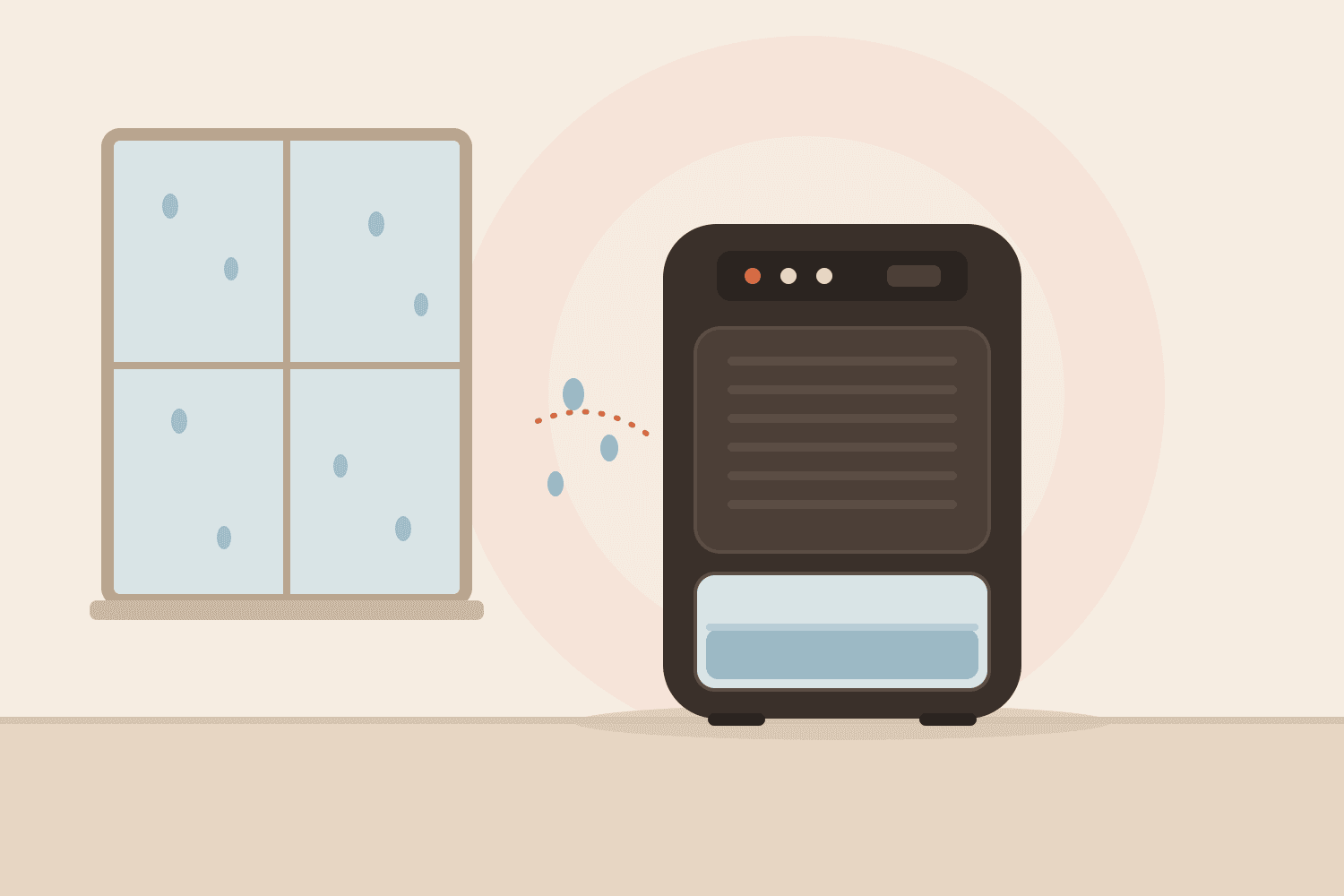
Wipe a bedroom window on a cold morning and the water on the cloth tells you something. The air in the room holds more moisture than the glass can carry. Government guidance calls condensation one of the most common causes of damp and mould in UK homes, and it forms when moisture from showering, cooking, drying laundry and breathing meets a surface that is colder than the air.
A dehumidifier lowers the moisture in a room’s air, so it can help, but as one step in a sequence: find where the moisture comes from, get it out of the building, keep the home warm enough, and only then decide whether an appliance adds anything. This guide sets out that order, says when a dehumidifier will not be enough, explains what renters can ask of a landlord, and describes the features worth having if you do buy one. Three models show those features.
This is general information and not a damp survey. It draws on GOV.UK, Shelter, Electrical Safety First, Which? and the makers’ manuals, read on 25 October 2026. Shopicks has not tested any of the dehumidifiers it mentions, and nothing here is a promise that one will clear condensation from your home.
Wide humidistat range
Meaco
A compact compressor model with a target range of 30% to 80% RH and a continuous setting. It shows how much room a humidistat can give you when you are trying to hold a bedroom steady.
Research-based assessment
Our assessment is based on product specifications, manufacturer information, market research and comparison with competing products. We have not physically tested this product.
A bedroom or small living room kept above 5°C, where you want to set a target precisely and can close the door.
Meaco’s page and manual agree on the extraction conditions, the humidistat range and the cleaning schedule, and the Amazon.co.uk listing carries MeacoDry ABC 10L in its Model Name row and ABC10W in its Part Number row. Amazon’s Model Number row (2021-01FU-4-26468) does not appear on Meaco’s pages, and Meaco sells the model in black, silver and white while the listing says Black. We have not tested it.
Adaptive control, larger tank
Ebac
A compressor model with a 3.5 L tank and adaptive control instead of a target you set. It is the example for deciding whether you want a humidity target or want the machine to decide.
Research-based assessment
Our assessment is based on product specifications, manufacturer information, market research and comparison with competing products. We have not physically tested this product.
Someone who would rather not choose a target humidity, in a room that stays above 3°C and where a larger tank matters.
Ebac’s page names the 2650e and its range list calls it ‘2650e (18L)’, which matches the Amazon.co.uk title. Ebac prints no model code, so we use the name. Ebac sells white and grey 2650e models, and we did not read the colour on the listing. The ‘guaranteed to solve all damp and condensation issues’ line on Ebac’s page is a sales claim we do not repeat. We have not tested its controls.
Rated 1°C to 40°C
EcoAir
A desiccant model with a timer and a laundry mode, rated for a wide temperature range. It is the example for a bedroom or hall that is cold enough to trouble a compressor.
Research-based assessment
Our assessment is based on product specifications, manufacturer information, market research and comparison with competing products. We have not physically tested this product.
A cold bedroom, hall or spare room where a compressor model would be outside its range, and where the higher power is acceptable.
EcoAir’s website SKU for the DD128 is DD-100005, which matches the Model Number row on the Amazon.co.uk listing. The listing’s title says Blue while a colour row says White, and colour is not treated as a different product. EcoAir’s manual for this model was not read, so the product page alone is the source. We have not tested it.
Warm air holds more water vapour than cold air. When damp air meets a colder surface, it cools, cannot hold all its water and leaves droplets. GOV.UK describes condensation damp as moisture generated inside the home that cools and condenses on colder parts of the building, such as window frames, corners and low points on walls behind sofas or wardrobes, and calls it the most common form of damp. Shelter describes the same thing as wet air forming water droplets on a cold surface such as a wall or window.
Over time condensation can lead to damp and mould growth, according to GOV.UK. That is why it matters even when the drops on the glass look harmless, and why wiping the windows each morning, as Shelter suggests, is a useful stopgap and not a cure.
Everyday living adds water to the air. Shelter lists cooking, boiling kettles, baths and showers, drying clothes indoors and even breathing. Government guidance says it is totally unreasonable to blame damp and mould on lifestyle choices, because cooking, bathing and drying laundry are unavoidable, and that the fundamental cause is building deficiencies, inadequate ventilation, inadequate heating or poor energy efficiency.
Within that, you can still reduce what reaches the air. Cover pans when cooking, shut the kitchen and bathroom doors while they are in use, mop up spills, and dry clothes outside or in a tumble dryer if you can, as Shelter and GOV.UK suggest. If you have to dry clothes indoors, our guide on drying clothes with a dehumidifier covers placement and settings.
Moisture that cannot leave the building condenses. Government guidance says rooms that produce a lot of moisture, such as kitchens and bathrooms, need adequate ventilation and working extractor fans. Shelter’s practical list for tenants is to use the extractor fans whenever you cook or wash, open windows for a short time every day, leave a gap between furniture and external walls, and not block air vents or air bricks. Which? gives similar first steps before the dehumidifier stage: an extractor fan or an open window when bathing, wiping down wet walls and floors, using the cooker hood and sealing cracks in walls.
A dehumidifier removes water from the air in the room. It does not bring in fresh air or push damp air out of the building, so it works best alongside ventilation and not instead of it, with doors and windows closed while it runs.
Government guidance says homes that are insufficiently insulated and heated are more prone to moisture and condensation on the inside of external walls and windows, and that cost-of-living pressures can lead tenants to heat their homes irregularly, which increases condensation. Shelter says warmer air holds more water, so a warm home means more water can stay in the air instead of collecting on windows, walls or ceilings.
Meaco’s manual is candid about the limit. It says the surface temperature of the windows can be too low for a dehumidifier to prevent condensation, which it calls common with single glazing and when the outdoor air temperature drops below freezing, and it advises running the dehumidifier on a lower target, or in its continuous mode, 24 hours a day until the weather warms. A dehumidifier cannot make a cold window warm.
Shelter says dehumidifiers take water out of the air and can help stop condensation in places where the air can be wetter, such as bathrooms or bedrooms. Which? says a dehumidifier can help limit mould growth by removing moisture from the air, and Electrical Safety First says dehumidifiers help reduce damp and mould, as long as they are used safely. They help most in a closed room, away from walls, furniture and curtains so that air can circulate, and left running long enough to bring the humidity down.
Expect a slow start. Meaco’s manual says a new unit may run constantly and collect a lot of water at first because it is removing the excess moisture in the home, and that this can take a couple of days or around four weeks, depending on the home. It also says that below 45% RH a dehumidifier will not collect much water, which is not a fault but a sign that the air is already dry.
Electrical Safety First says a dehumidifier does not fix the underlying causes of damp, such as condensation, rising damp or structural leaks, and that if damp problems persist you should investigate and repair the root cause. GOV.UK separates condensation from penetrating damp, rising damp and damp from leaking pipes, and says landlords should use a qualified professional to avoid misdiagnosis. Shelter says damp patches on external walls can be a sign of penetrating damp and lists leaking roofs, faulty guttering, cracks in external walls, internal leaks and plumbing problems as causes.
A smell of mould with no visible mould can mean mould behind a surface, such as wallpaper or furniture, according to GOV.UK. Mould that is already growing needs cleaning, not drying. GOV.UK says most tenants could reasonably remove condensation and very small amounts of mould with an appropriate mould and mildew cleaner, that larger areas should be dealt with by a professional, and that photographing the mould first helps identify the source. It also says the risk from damp and mould is greater for some people, including those with underlying health conditions or weakened immune systems. We do not give a mould removal method here, because black mould and cleaning chemicals are a separate safety topic.
Shelter England’s advice for private tenants is to tell your landlord about damp and mould in writing, keep a record of conversations, emails and messages, and give the landlord access to inspect. The landlord must try to find out what is causing the problem and, if they cannot, should ask a damp surveyor, which you do not pay for. Say where the damp is, when you see it, what you have tried, and whether anyone in the home has a health condition. GOV.UK says it is advisable to photograph the area before the mould is cleaned.
Shelter says your landlord must fix problems such as structural faults, leaking internal pipes, poor ventilation, broken heating, cracked walls, rotten window frames and leaking roofs, and is responsible for extractor fans they have installed. It says a landlord should not tell you to paint over mould that keeps coming back, say the problem is just condensation without checking, or tell you to stop cooking or showering. If you have no outside space, it says a landlord should not ban you from drying clothes indoors and could help with a solution such as a dryer or dehumidifier. Its page for social housing tenants adds that if a landlord says you should use a dehumidifier, you should talk to them about helping with the cost. If nothing happens, you can ask your council for an environmental health inspection. Shelter England’s advice covers England; the rules differ in Scotland, Wales and Northern Ireland.
Look first at the humidistat. Target ranges run from 30% to 80% RH on the Meaco ABC 10L and 40% to 70% on the Arete One, and manuals suggest targets around 50% to 55%. A humidity reader (hygrometer) tells you what the room is doing. Then look at the night or sleep mode and the noise figure, remembering that no maker prints measurement conditions, since a bedroom unit runs when you are trying to sleep.
The operating range matters in an unheated room: compressor models print lower limits from 3°C to 15°C and desiccant models 1°C. Also check how the water leaves. A tank that fills overnight stops the unit, so a larger tank, a hose to a drain, or both help. Finally, check for auto-restart after a power cut and for a timer.
Energy use is rated power in kilowatts multiplied by the hours it runs. As an illustration, a unit drawing 165 W, as Meaco gives for the ABC 10L, for eight hours would use about 1.3 kWh, and a unit drawing 623 W, as EcoAir gives for the DD128 on high, about 5 kWh. These are constant-power scenarios from printed wattages, not measurements. Actual use varies with the mode, the room conditions and how often the humidistat switches the compressor on and off. Multiply by your own unit rate to get a cost. Which? found a wide spread in how efficiently different models remove water.
Do not set the target lower than you need. Meaco’s manual notes that a dehumidifier collects little water below 45% RH, and its smart humidity mode sleeps for 30 minutes between checks once the target is reached. Keeping doors and windows shut, and cleaning the filter, stops the unit working harder than necessary.
Read the humidity on the unit or a separate hygrometer over several days, wipe the windows and note whether the water is less, and look at how much water collects in the tank. If the humidity falls but the windows still run with water, the glass may simply be too cold, as Meaco’s manual says. If the tank collects almost nothing and the room already reads below your target, the air is dry enough and the machine is correctly idle.
If condensation, damp or mould persists after several weeks with sensible settings and the doors closed, treat that as a sign of a cause that an appliance cannot reach: a ventilation fault, a cold bridge, a leak or a heating problem. In a rented home, tell the landlord in writing; in your own, ask a qualified surveyor or damp specialist.
Our assessment is based on product specifications, manufacturer information, market research and comparison with competing products. The products on this page have not been physically tested by Shopicks.
It can help by lowering the moisture in the room’s air, and Shelter says dehumidifiers can help stop condensation in places such as bedrooms and bathrooms. It cannot warm a cold window, and Meaco’s manual says the glass can be too cold for a dehumidifier to prevent condensation, especially with single glazing in freezing weather.
Yes. GOV.UK treats ventilation, adequate heating and building faults as the main ways to deal with condensation, and Which? lists simple steps, such as using the extractor fan, wiping wet surfaces and drying clothes outside, to try before the dehumidifier stage.
No. It lowers the moisture that lets mould grow, but it does not remove mould that is already there, and GOV.UK says removing surface mould alone will not stop it reappearing unless the causes are dealt with. For anything but a very small area, GOV.UK says to use a professional.
Shelter says that if a landlord tells you to use a dehumidifier you should talk to them about the cost, and that a landlord must fix structural faults and poor ventilation. It says a landlord should not tell you the problem is just condensation without checking the cause.
Makers advise running it until the humidity reaches your target and letting a humidistat manage it after that. Meaco’s manual says a new unit can run constantly for a couple of days or around four weeks while it removes the excess moisture. Check your own manual for the settings that suit your model.
Amazon only permits prices, ratings and review counts to be shown from its own site or API, and a stale value would mislead you. Each button links to the Amazon.co.uk listing, where you can see the current price, availability and customer reviews.
Condensation damp, ventilation, heating, misdiagnosis, removing small amounts of mould and why lifestyle is not the cause. Updated 1 April 2026.
What causes condensation, the five steps and what a landlord should do. Last updated 27 October 2025 on the page.
Telling a landlord in writing, what a landlord must fix and what to do if nothing happens. Applies to England.
Simple steps before a dehumidifier, how to use one and features. Test results are behind a paywall and are not used.
What a dehumidifier does not fix, and placement and safe use.
Humidistat ranges, temperature limits, noise and the manual wording on cold windows are from the makers’ pages and manuals recorded in the Home & Living evidence dataset.
Used only to confirm the title, manufacturer and model number behind each ASIN. No Amazon prices, ratings, images or descriptions are used.

Home & Living
How compressor and desiccant dehumidifiers differ in room temperature, rated extraction, power, weight, noise and upkeep, using maker figures.
Home & Living
How to choose a dehumidifier in the UK: compressor or desiccant, litres per day and test conditions, controls, tanks and noise, with five models checked.
Home & Living
Drying laundry indoors with a dehumidifier: room set-up, clearances, laundry settings, energy use and how it compares with a heated airer or tumble dryer.