Home & Living
Dehumidifier Buying Guide UK: Type, Size, Controls and Models Checked
How to choose a dehumidifier in the UK: compressor or desiccant, litres per day and test conditions, controls, tanks and noise, with five models checked.
Home & LivingComparison
The right type depends mostly on how cold the room gets, and on reading litres per day with the conditions behind it. These are the differences that matter, with the makers’ own figures for the twelve models in our listing.
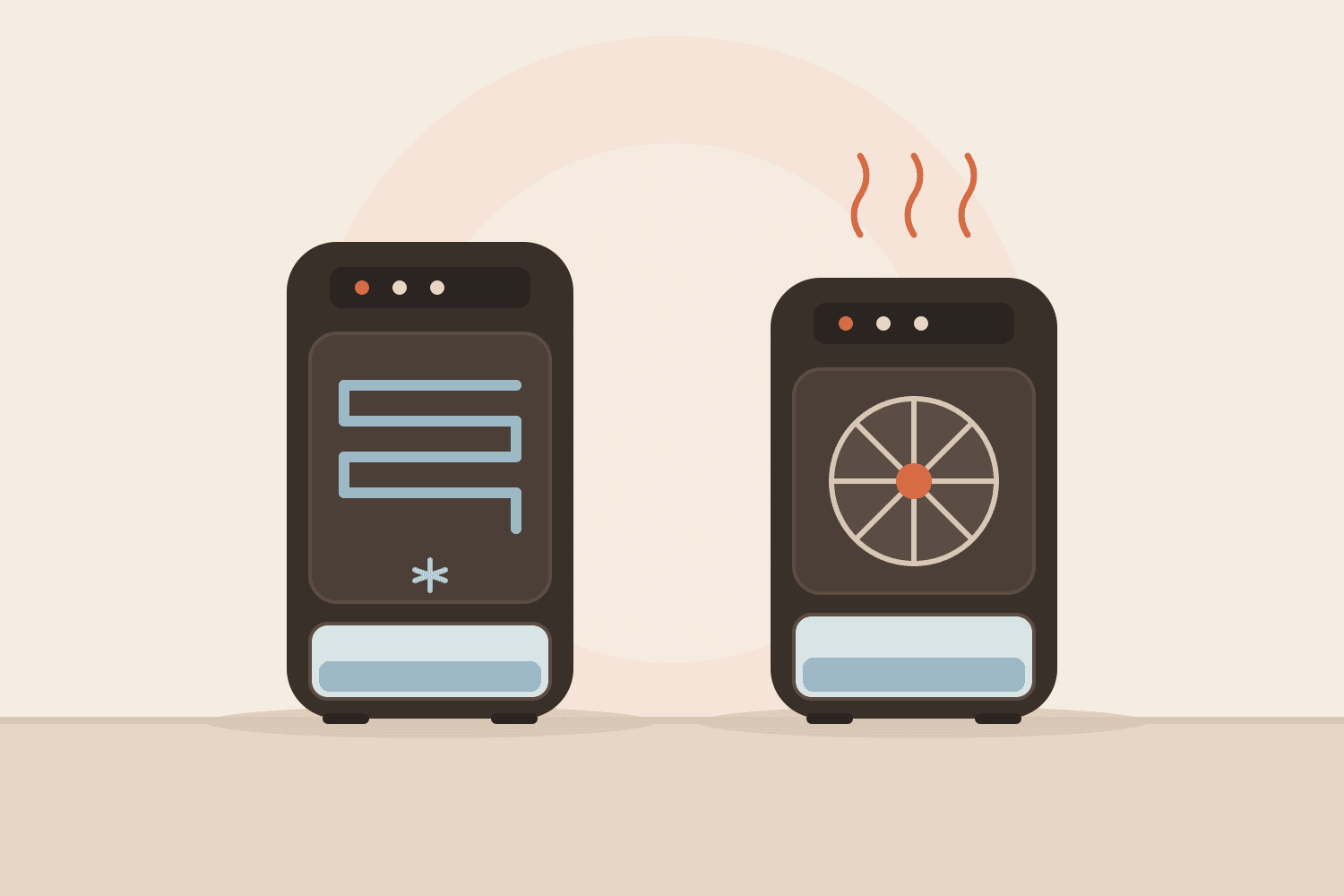
Draws damp air over a cold surface so that water condenses into the tank, then warms the dried air again. Eight of the twelve models in our listing are compressors, listed at 9.5 to 13 kg, and the Meaco Arete One 12L is the worked example here.
A room that is usually heated, such as a living room or bedroom, where running cost matters.
Research-based assessment
Our assessment is based on product specifications, manufacturer information, market research and comparison with competing products. We have not physically tested this product.
Passes air over an absorbent wheel that a heater dries out again to release the moisture. Four of the twelve models in our listing are desiccant, listed at 6 to 8.7 kg, and the Meaco DD8L Pro is the worked example here.
An unheated garage, conservatory or outbuilding, a cold room, or a small space where weight matters.
Research-based assessment
Our assessment is based on product specifications, manufacturer information, market research and comparison with competing products. We have not physically tested this product.
Meaco’s manual for the ABC range describes the compressor principle: a fan draws humid air across a filter and through an evaporator, where the air is cooled below its dew point so that water vapour forms as condensate on the coils and flows into the tank, and a condenser then reheats the cooled, dried air. Recycling the room’s air through the unit repeatedly lowers its relative humidity.
Which? describes the desiccant type as using a wheel that absorbs moisture from the air, with an internal heater and fan that drive the moisture off the wheel so the cycle repeats. That heater explains two things in the manuals: EcoAir says its desiccant models release slightly warm air, and Meaco’s DD8L Pro asks you not to unplug it until it has finished cooling down.
Which? says refrigerant models typically struggle in colder spaces, such as cellars, and that desiccant models work in both warm and cold ones. Electrical Safety First says compressors work best in warmer temperatures, and desiccants perform better in cooler or unheated environments. The makers’ own limits show how the line falls: the compressors in our listing print lower limits of 3°C (Ebac), 5°C (Meaco, Pro Breeze, NETTA) and 15°C (EcoAir DC12 MK3), while all four desiccant models print 1°C.
No source gives a single cut-off. EcoAir’s DC12 MK3 manual gives 15°C as its minimum ambient temperature and says it defrosts periodically below that, and Pro Breeze’s product page says desiccant models are more effective below 15°C and compressors more efficient above 20°C. Those are makers’ statements, they differ from one another and we have not tested them. Meaco’s ABC manual does not recommend use below 5°C. For a room that is regularly colder than about 15°C, a desiccant model is the safer reading of the evidence; for a heated room, either works and the compressor is usually cheaper to run.
A litres per day rating is the water removed in 24 hours in a stated test room, and the test room differs by type and by maker. In our listing the compressor models that print conditions use 30°C and 80% RH (the Meaco Arete One 12L and ABC 10L, the Pro Breeze PB-18 manual and the EcoAir DC12 MK3), while the desiccant models use 20°C and 60% RH (EcoAir’s three, and Meaco’s DD8L Pro). A 12 L rating at 30°C and 80% RH and an 8 L rating at 20°C and 60% RH therefore describe different rooms and cannot be compared as they stand.
Meaco’s own pairs of figures show the effect. The Arete One 12L prints 12 L at 30°C and 80% RH but 7.5 L at 27°C and 60% RH, and the DD8L Pro prints 2.12, 5.4 and 7.97 L/day on fan speeds 1, 2 and 3 at 20°C and 60% RH. The 7.5 L and 7.97 L figures sit close together, but at different temperatures, so they are not proof that the two machines would remove the same water in your room. Which? tests extraction at 21°C and again at 10°C so that cold performance can be seen, but its results are behind a paywall and Shopicks has not used them.
Rated power in our listing runs from 165 W to 330 W for the compressors where it is printed, and from 231 W to 670 W for the desiccants (the DD128 also lists 25 W while it samples the air). The DD8L Pro varies with fan speed, 231 W at speed 1 and 623 W at speed 3, and the DD1 Simple MK3 draws 300 W in low mode and 580 W in high. Which? says desiccant models are more expensive to run than refrigerant ones, and Electrical Safety First says they may use more energy overall.
Energy used is rated power in kilowatts multiplied by hours. As an illustration, a 165 W compressor drawing that power for 8 hours would use about 1.3 kWh, and a 580 W desiccant model drawing its high-mode figure for the same time about 4.6 kWh. These are constant-power scenarios built from the makers’ printed wattages, not measurements and not maximums. Actual use varies with the room conditions, the mode selected and how often the humidistat switches the machine on and off. Multiply a figure by your own unit rate to get a cost, and remember that a desiccant model also gives out heat that may offset some heating in a cold room, which we have not measured.
The compressors in our listing are listed at 9.5 kg (EcoAir DC12 MK3) to 13 kg (Pro Breeze 20L Smart and both Ebac models), and the desiccant models at 6 kg (EcoAir DD1 Simple MK3) to 8.7 kg (Meaco DD8L Pro). A lighter machine is easier to carry between floors, but weight is not the only factor. The Meaco Arete One 12L and the EcoAir DC12 MK3 list castors, the ABC 10L and the DD8L Pro sell castors separately, and the tank is heavy when it is full.
The printed noise figures run from 35 dB to 45 dB for the compressors and from 34 dB to 54 dB for the desiccants, but no maker prints the distance or the setting, and some print two figures without saying which setting each describes. Meaco’s ABC page says ‘from 36 dB’ while its manual says ‘maximum 40 dB(A)’ at one metre, and the DD8L Pro manual gives 40, 47 and 50 dB by fan speed. Treat them as indications of each maker’s own quietest setting, not as a ranking.
Which? rates quietness subjectively on the highest and lowest settings in its lab. Both types have night or sleep modes in some models. Meaco’s DD8L Pro manual adds that a dehumidifier will be noisier on a wooden floor than on carpet.
Both types need the same basic care: Meaco, Pro Breeze and EcoAir all say to clean the dust or air filter at least every two weeks, to empty the tank after use and to avoid blocking the air inlet. EcoAir says to replace the outer filter of a DD1 Simple about every 6 months, and Meaco says the HEPA filter supplied with the Arete One needs replacing roughly every 3 months.
The differences are small and practical. A compressor model should be kept upright and left to stand after being moved, which Meaco’s ABC manual puts at 30 minutes and the Arete One manual at six hours before first use, and several manuals say the sealed circuit holds a flammable refrigerant (R290) that only a trained engineer should service. A desiccant model needs a cooling-down period before you unplug it, and a drain hose should not be left outside below 1°C, which EcoAir and Pro Breeze both say.
A flat or house heated through the winter, with a bedroom or living room to dry out, is the usual case for a compressor model, and it is the type with the most choice. A garage, outbuilding, cold hall or conservatory that is not heated is where a desiccant model earns its higher running cost. A home with both, such as a heated house with a cold utility room, may need to choose by the room that matters most.
A household that dries a lot of laundry indoors should read the laundry guide, because the laundry setting, the tank size and the clearance matter more than the type. A renter should read the condensation guide first, because Shelter says a landlord should look for the cause of condensation, and the type of dehumidifier is a second question.
| Compressor (8 models) | Desiccant (4 models) | |
|---|---|---|
| Models in our listing | Meaco Arete One 12L and ABC 10L, Pro Breeze PB-18 and 20L Smart, EcoAir DC12 MK3, Ebac 2650e and 3850e, NETTA 103104 | Meaco DD8L Pro, EcoAir DD1 Simple MK3, DD128 and DD3 Simple |
| Lowest operating temperature printed | 3°C (Ebac), 5°C (Meaco, Pro Breeze, NETTA), 15°C (EcoAir DC12 MK3) | 1°C on all four |
| Extraction conditions printed | 30°C and 80% RH (Meaco, Pro Breeze PB-18 manual, EcoAir DC12 MK3); also 27°C and 60% RH on the Arete One; none on Ebac, NETTA or the Pro Breeze 20L Smart | 20°C and 60% RH on all four |
| Rated power | 165 W to 330 W where printed; Ebac prints a maximum of 190 W | 231 W to 670 W, by setting |
| Water tank | 1.5 L to 4 L | 2 L to 3.5 L |
| Weight (makers) | 9.5 kg to 13 kg | 6 kg to 8.7 kg |
| Noise printed (no conditions) | 35 dB to 45 dB | 34 dB to 54 dB |
| Efficiency (Which? and Electrical Safety First) | Generally more efficient in warmer temperatures | More expensive to run than refrigerant models |
| Cold-room suitability (Which?) | Typically struggle in colder spaces | Work in both warm and cold spaces |
How to choose a dehumidifier: litres per day, tank size, controls, noise and care, with five models checked.
Why window condensation forms, what to try first and what renters can ask a landlord.
Room set-up, laundry settings, clearances and how the energy use compares.
Planned. We do not have a listing or guide for passive moisture absorbers yet, so we make no recommendation about them.
Our assessment is based on product specifications, manufacturer information, market research and comparison with competing products. The products on this page have not been physically tested by Shopicks.
A desiccant model is the safer choice. Which? says refrigerant models typically struggle in cold spaces and that desiccant models work in both warm and cold ones, and every desiccant model in our listing prints a lowest operating temperature of 1°C.
Partly because ratings are measured in different conditions. The desiccant models in our listing print 7.5 L to 10 L at 20°C and 60% RH, while the compressors print their headline figure at 30°C and 80% RH. The figures cannot be compared as they stand.
Which? says desiccant dehumidifiers are more expensive to run than refrigerant models, and Electrical Safety First says desiccants may use more energy overall. Compare rated watts multiplied by hours, and use your own unit rate.
Either can do it. Which? says both types are available with a laundry setting and any dehumidifier can dry laundry. Match the type to the temperature of the room, and read the manual on clearance and unattended use.
Only if the garage stays within the model’s range. Pro Breeze’s manual warns that below 5°C the coils may freeze, EcoAir’s DC12 MK3 manual says it defrosts periodically below 15°C, and Which? generally suggests a desiccant for an unheated garage.
How the types work, where each suits and how Which? tests extraction at 21°C and 10°C. Test results are behind a paywall and are not used.
Desiccant models costing more to run, and laundry settings on both types.
Where each type performs better and how their energy use compares.
Operating ranges, extraction conditions, power, weight, noise and upkeep are from the makers’ pages and manuals recorded in the Home & Living evidence dataset. The cold-room thresholds are makers’ statements.
Used only to confirm the title, manufacturer and model number behind each ASIN. No Amazon prices, ratings, images or descriptions are used.
Home & Living
How to choose a dehumidifier in the UK: compressor or desiccant, litres per day and test conditions, controls, tanks and noise, with five models checked.
Home & Living
Why window condensation forms, what to try before a dehumidifier, when one helps and when it does not, and what renters can ask a landlord, with GOV.UK advice.
Home & Living
Drying laundry indoors with a dehumidifier: room set-up, clearances, laundry settings, energy use and how it compares with a heated airer or tumble dryer.