Home & Living
Compressor vs Desiccant Dehumidifier: Which Suits Your Room?
How compressor and desiccant dehumidifiers differ in room temperature, rated extraction, power, weight, noise and upkeep, using maker figures.
The litres figure on the box is a rating made in a test room, not a promise about yours. This guide explains how to read it, then looks at five models whose makers print enough detail to read properly.
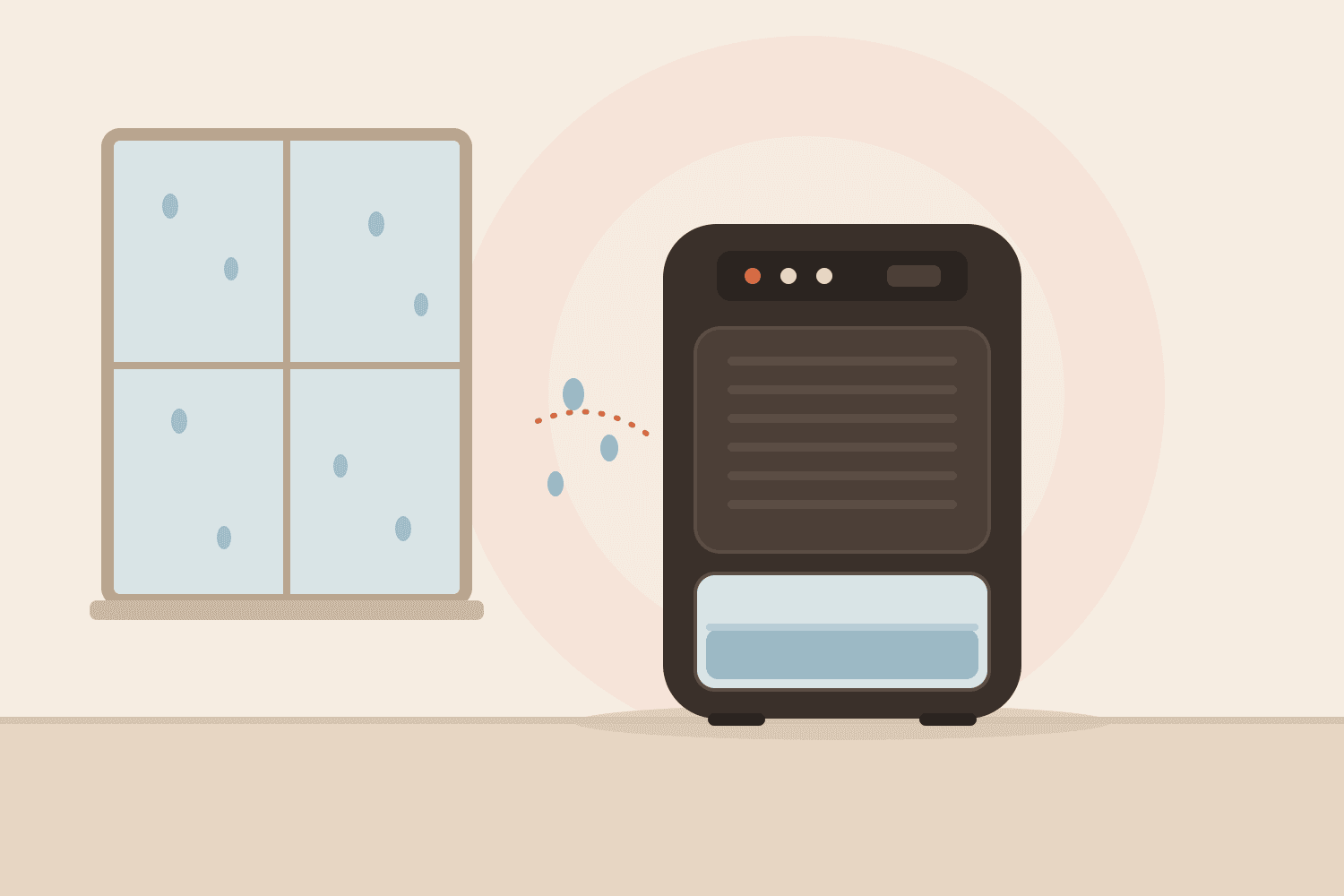
Most mistakes in buying a dehumidifier come from treating one number as a verdict. The litres per day on the box is the water a unit removes in 24 hours in a stated test room, usually a warm and very humid one. It says nothing about the size of the water tank, and little about how the machine behaves in a cool bedroom in January.
This guide takes five dehumidifiers as worked examples: a compressor model that prints its rating at two sets of conditions, a compact compressor with two drain hoses, a desiccant model rated down to 1°C, a compressor with a stated 15°C lower limit, and a model whose maker prints no rating at all. They were chosen because the makers’ own pages and manuals are specific and because each Amazon.co.uk listing matches the maker’s model, not because they are the best of their kind. They are not a ranking. Our Dehumidifiers listing covers twelve models.
Shopicks has not tested any of them. Everything here comes from manufacturer pages and manuals read on 25 October 2026, plus UK government, consumer and safety advice, and the guide says where a figure is missing, conflicting or printed without conditions. If the real problem is damp that keeps returning, read the condensation guide first, because a dehumidifier treats moisture and not its cause.
Extraction with its conditions
Meaco
A compressor model that prints two extraction figures at two sets of test conditions, alongside the tank, the operating range and the filter schedule. It is the clearest example here of how far a rating depends on the room it was measured in.
Research-based assessment
Our assessment is based on product specifications, manufacturer information, market research and comparison with competing products. We have not physically tested this product.
A heated room, for someone who wants the conditions behind the litres printed and is happy to replace a HEPA filter.
Meaco’s page and manual agree on every figure used here, and the Amazon.co.uk listing carries the Arete One 12L in its title, Model Name and Part Number rows. Amazon’s Model Number row (AreteOne-12L-50m²) is Amazon’s own and Meaco prints no separate model code, so we use the product name. We left out Meaco’s water removal table because its figures do not agree with each other. We have not tested how it performs.
One condition, hoses included
Pro Breeze
A compact compressor model that ships with two drain hoses. Its manual prints the extraction at 30°C and 80% RH, while the product page prints the same 12 L with no conditions, which shows why it pays to read the manual.
Research-based assessment
Our assessment is based on product specifications, manufacturer information, market research and comparison with competing products. We have not physically tested this product.
A single room kept above 5°C where a hose to a sink or drain is possible.
Pro Breeze’s page and manual name the OmniDry 12L as the PB-18, and two of the three model rows on the Amazon.co.uk listing say PB-18. The third, PB-D-24-WF, belongs to a larger Pro Breeze model, so that conflict is recorded and the listing is used on the strength of the title and the other two rows. A second Pro Breeze 12L listing with conflicting rows was left out. We have not tested it.
Desiccant, rated from 1°C
EcoAir
A light desiccant model with a rotary dial. EcoAir prints its extraction at 20°C and 60% RH and rates it down to 1°C, so it shows what the desiccant type offers in a cooler room.
Research-based assessment
Our assessment is based on product specifications, manufacturer information, market research and comparison with competing products. We have not physically tested this product.
A cooler room, a hall or an unheated space where a compressor would struggle, and someone who wants one dial.
EcoAir’s own site gives the Blue DD1 Simple MK3 the SKU DD-100001, which is the model on the Amazon.co.uk listing, and its page and manual agree on the figures used. The manual’s document code (DD-100019) is a document number, not a colour code. The listing’s Laundry label is not matched by a laundry mode on EcoAir’s page, so we do not claim one. We have not tested its drying.
Stated 15°C lower limit
EcoAir
A compressor model that states its lower temperature limit more plainly than most. It is the example for checking the operating range before choosing a compressor for a cool room.
Research-based assessment
Our assessment is based on product specifications, manufacturer information, market research and comparison with competing products. We have not physically tested this product.
A room that stays comfortably heated, where a hose to a drain is available and a rated power of 210 W to 240 W appeals.
EcoAir’s website SKU for the DC12 MK3 is DC-100015, which matches the Model Number and Part Number rows on the Amazon.co.uk listing and the manual’s title, and EcoAir’s page and manual agree on the temperature range. We have not tested its performance in a cool room.
Adaptive control, no printed rate
Ebac
A compressor model from a County Durham maker that sells adaptive control rather than a figure. Ebac’s page gives no litres per day, so it is the example for reading a rating you cannot trace to its conditions.
Research-based assessment
Our assessment is based on product specifications, manufacturer information, market research and comparison with competing products. We have not physically tested this product.
Someone who prefers adaptive control to setting a target humidity, in a room that stays above 3°C, and who can ask Ebac about the rating.
Ebac’s page names the 3850e and its range list calls it ‘3850e (21L)’, which matches the Amazon.co.uk title. Ebac prints no model code, and the code in Amazon’s rows (DI821WG-GB) is Amazon’s, so we use the name. The ‘guaranteed to solve all damp and condensation issues’ line on Ebac’s page is a sales claim that we do not repeat. We have not tested its controls.
| Arete One 12L | OmniDry 12L PB-18 | DD1 Simple MK3 | DC12 MK3 | Ebac 3850e | |
|---|---|---|---|---|---|
| Type | Compressor | Compressor | Desiccant | Compressor | Compressor |
| Extraction as printed | 7.5 L at 27°C and 60% RH; 12 L at 30°C and 80% RH | 12 L at 30°C and 80% RH (manual) | 7.5 L at 20°C and 60% RH | 12 L at 30°C and 80% RH | None printed; 21 L in Ebac’s range list |
| Water tank | 2.5 L | 2 L | 2 L | 2 L | 2.5 L |
| Operating range | 5°C to 35°C | 5°C to 35°C | 1°C to 35°C | 15°C to 35°C | 3°C to 35°C |
| Rated power | 165 W | 200 W | 300 W low, 580 W high | 210 W low, 240 W high | Max 190 W |
| Target humidity | 40% to 70% RH | 30% to 80% RH | Rotary dial | 30% to 80% RH | Smart Control |
| Continuous drainage | Option, hose not included | Two hoses included | Option, 12 mm hose | Hose included | Option, bought separately |
| Weight | 10.9 kg | 10 kg net | 6 kg net | 9.5 kg net | 13 kg |
| Noise (no conditions printed) | From 35 dB | 36 dB | 34/47 dB(A) | 39 dB(A) | 44 dBa |
Write down what the dehumidifier is for before you compare models: condensation on bedroom windows, a damp utility room, wet washing, or a cold garage. They need different things. A bedroom wants quiet running and a humidity target you can set, laundry wants a mode that keeps the fan fast for hours, and an unheated outbuilding wants a unit rated for low temperatures.
Check the cause as well. A dehumidifier lowers the moisture in the air but does not mend a leak, replace a broken extractor fan or warm a cold wall, and government guidance says that dealing with surface mould alone will not stop it returning. Our guides on condensation and on drying laundry indoors cover those two jobs in more depth.
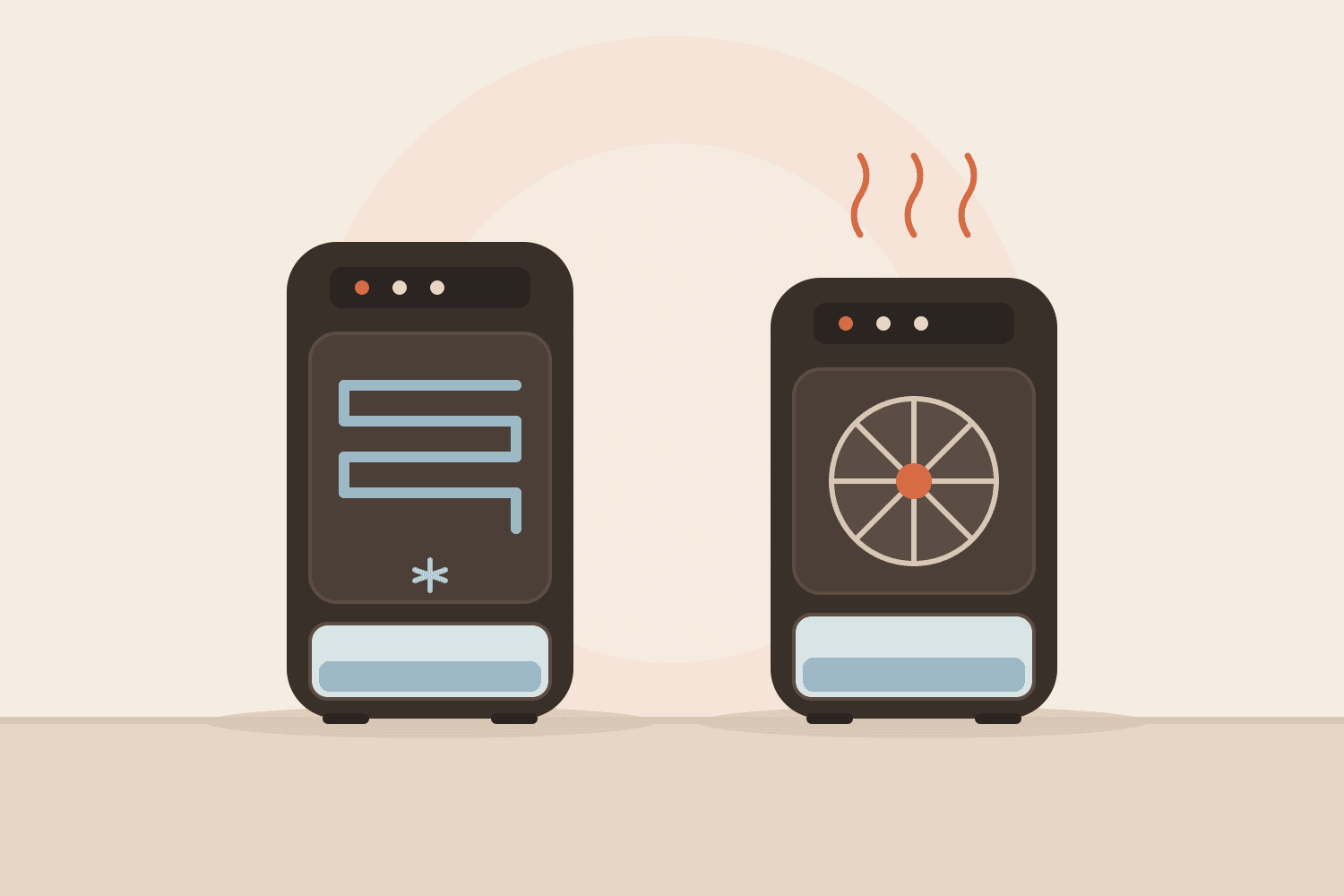
A compressor (refrigerant) model cools the air over a cold surface so that water condenses into the tank. A desiccant model uses an absorbent wheel that is heated to release the moisture. Which? says refrigerant models typically struggle in colder spaces and desiccant models work in both warm and cold ones, and that for an unheated garage, conservatory or outbuilding you should generally choose a desiccant. Electrical Safety First says compressors work best and are generally more energy efficient in warmer temperatures, and that desiccant types may use more energy overall. Which? agrees that desiccant models are more expensive to run.
The makers’ limits show the difference in practice. EcoAir rates the DD1 Simple MK3 from 1°C, while the compressors here print 3°C, 5°C or, for the DC12 MK3, 15°C. EcoAir’s manual says the DC12 MK3 defrosts periodically below 15°C, and Pro Breeze’s manual warns that the coils may freeze below 5°C. Our comparison of the two types goes through the trade-offs.
A rating is the water removed in 24 hours in a stated test room. The Meaco Arete One 12L, the Pro Breeze PB-18 (in its manual) and the EcoAir DC12 MK3 all print 12 L at 30°C and 80% RH, a hot and very humid room. EcoAir’s DD1 Simple MK3 prints 7.5 L at 20°C and 60% RH, a mild one. Meaco prints both kinds of condition for the Arete One: 12 L at 30°C and 80% RH but 7.5 L at 27°C and 60% RH. Ebac and Pro Breeze’s 20L Smart print a figure with no conditions, or none at all, so it cannot be compared with these.
Ebac argues the opposite case on its own website: that quoted extraction rates can mislead because they refer to conditions not found in the UK, and that a unit with adaptive control suits a home better than a large one. That is the view of a company that sells adaptive control, and we have not tested it. The fair reading is that a rating helps you choose between sizes only when the conditions are printed and match.
Which? says capacity is the litres a unit can remove each day, which is different from the tank, and that the right size depends on the size of the space, how many people create moisture through cooking, washing and drying laundry, and how bad the damp is. It puts 7 to 12 L in a small band, for a single person in a small flat with a mild problem, 14 to 16 L in a medium band for more people or a worse problem, and 18 L or more in a large band, for a lot of moisture or laundry dried indoors.
Rated room sizes are sales claims and not measurements. Pro Breeze says up to 20 m² for the PB-18, Ebac gives home sizes of 225 m² for the 3850e and 180 m² for the 2650e, and Amazon’s own model row for the Meaco lists 50 m². A humidity reader (hygrometer) is a better guide than a floor area: makers describe comfortable humidity as roughly 40% to 60% RH, and Meaco’s manual suggests a target of about 55%. A unit that is too small for the moisture it faces runs continuously and fills its tank, and the answer then is to reduce the moisture, not only to buy a bigger machine.
Which? says a humidistat monitors the moisture in the air and adjusts the machine to hold the level you set, and that some models also have a more nuanced auto setting. Ranges differ. The Meaco Arete One sets 40% to 70% RH, the Pro Breeze PB-18 and EcoAir DC12 MK3 30% to 80%, the DD1 Simple uses a dial, and Ebac’s Smart Control prints no target range. Meaco’s continuous (CO) setting never switches off whatever the humidity.
Auto-restart after a power cut is listed by Meaco, EcoAir and NETTA, and timers range from an off timer to a 24-hour programme. Which? points out that a timer can save money on a tariff with cheaper hours, and says it tests how accurate each humidistat is, which Shopicks cannot see because the results are behind a paywall.
The tank holds the water and the rating describes how fast it arrives. The tanks in our listing run from 1.5 L to 4 L and do not follow the ratings: Ebac’s 2650e has a 3.5 L tank while its 3850e, listed with the larger capacity, has 2.5 L. When the tank is full the unit stops, so a small tank on a hard-working machine in a damp room needs emptying often.
Continuous drainage avoids that. Which? says you often have to buy the hose separately, and the makers differ: Pro Breeze and EcoAir’s DC12 MK3 list hoses in the box, Meaco lists an adaptor for a garden hose, and Ebac sells permanent drainage as an extra. The hose must run downhill without kinks, and both EcoAir’s and Pro Breeze’s manuals say not to leave the end of a hose outside when the temperature is below 1°C.
Which? says you can use any dehumidifier to dry laundry, with the target set to 30% to 40% if there is no laundry setting, and in its test a dehumidifier almost halved the drying time of two identical loads. Laundry modes differ: Meaco’s Arete One targets 35% RH on high fan for 6 hours, while EcoAir’s DC12 MK3 manual says not to use its laundry mode for long periods or unattended. Our guide on drying clothes with a dehumidifier covers set-up, placement and safety.
Every noise figure in this guide is printed without measurement conditions, and some are a single ‘from’ value. Meaco’s ABC 10L page says ‘from 36 dB’ while its manual says ‘maximum 40 dB(A)’ at one metre, and EcoAir prints 34/47 dB(A) for the DD1 Simple without saying which setting each belongs to. Meaco’s manual says removing the HEPA filter lowers the noise by 4 to 5 dB. Which? rates quietness subjectively on the highest and lowest settings in its lab, and we do not call any model the quietest.
Where you put it matters too. Meaco’s manual for the DD8L Pro says a dehumidifier will be noisier on wooden floors than on carpet, and Which? suggests a night or silent mode if you will run it while you sleep.
Cleaning the filter is the most common instruction: Meaco, Pro Breeze and EcoAir all say to clean it at least every two weeks, Meaco says a HEPA filter needs replacing roughly every 3 months, and EcoAir says to replace its outer filter about every 6 months. Which? says to vacuum the room before using a dehumidifier, empty the tank after use and wipe it to avoid mould, and that manufacturers tell it a blocked filter is a very common reason for a unit not working. Keep a compressor upright: Meaco asks you to leave it standing for six hours before first use, and EcoAir asks for four hours.
Electrical Safety First says to buy from a reputable retailer or directly from a known maker rather than a third-party online seller, whose unverified products may not meet UK safety standards, so check who sells the item on Amazon.co.uk before you order. It also says to avoid second-hand units, look for UKCA or CE marks, register the product for recall notices and use a socket with RCD protection. It also advises against running a dehumidifier overnight or while you are away unless the maker says that is safe. Several manuals say the R290 refrigerant is flammable and ask you to keep the unit away from ignition sources.
A maker’s page and manual can tell you the model, the tank size, the temperature range, the clearance it needs, the warranty and how to use the controls. They cannot tell you how the machine will perform in your room, whether the noise suits your bedroom, or how it compares with a rival, because each maker chooses its own conditions. Listings also repeat lines such as an award, ‘quietest’ or ‘guaranteed to solve’ that Shopicks cannot check, and we do not repeat them.
Where claims conflict we say so: Pro Breeze’s page and manual differ on the 20L Smart’s operating range, Ebac’s Amazon.co.uk title says a two year warranty while its page says five years when bought direct, and Meaco’s water removal table disagrees with itself. Ask the maker for the test conditions behind any number that matters to you.
Our assessment is based on product specifications, manufacturer information, market research and comparison with competing products. The products on this page have not been physically tested by Shopicks.
Litres per day is the rating for how much water a unit removes in 24 hours under stated test conditions. Tank size is how much it can hold before it stops. Which? makes the same distinction, and in our listing the tanks run from 1.5 L to 4 L whatever the rating.
Neither is better in every room. Which? says compressor models typically struggle in colder spaces and desiccant models work in warm and cold ones, and Electrical Safety First says compressors are generally more energy efficient in warm temperatures. Match the type to the usual temperature of the room.
It depends on the moisture and not only the floor area. Which? puts 7 to 12 L in a small band for a single person in a small flat with a mild problem and 14 to 16 L in a medium band for more people or a worse problem. Rated room sizes are makers’ claims, so a humidity reader is a better guide than a number of square metres.
Only if the manual says it is safe. Electrical Safety First advises avoiding running a dehumidifier overnight or while you are away unless the maker specifies it is safe for unattended use. Check the manual for your model.
It can limit mould growth by removing moisture from the air, as Which? says, but it does not remove mould that is already there or fix the cause. Government guidance says removing surface mould alone will not stop it reappearing unless the underlying causes, such as condensation, poor ventilation or building faults, are dealt with.
Amazon only permits prices, ratings and review counts to be shown from its own site or API, and a stale value would mislead you. Each button links to the Amazon.co.uk listing, where you can see the current price, availability and customer reviews.
Types, capacity bands, tank versus capacity, features, how to use a dehumidifier and how Which? tests. Test results are behind a paywall and are not used.
The drying-time test, laundry settings and the 30% to 40% target.
Desiccant models costing more to run than refrigerant models.
Type differences, buying and registering, placement, filters, overnight use and RCD protection.
Why removing surface mould is not enough, and condensation, ventilation and heating as causes.
Extraction, tank, temperature, power, noise, clearance and filter figures are from the makers’ pages and manuals recorded in the Home & Living evidence dataset.
Used only to confirm the title, manufacturer and model number behind each ASIN. No Amazon prices, ratings, images or descriptions are used.
Home & Living
How compressor and desiccant dehumidifiers differ in room temperature, rated extraction, power, weight, noise and upkeep, using maker figures.

Home & Living
Why window condensation forms, what to try before a dehumidifier, when one helps and when it does not, and what renters can ask a landlord, with GOV.UK advice.
Home & Living
Drying laundry indoors with a dehumidifier: room set-up, clearances, laundry settings, energy use and how it compares with a heated airer or tumble dryer.