Buying guide
Dehumidifier Buying Guide UK: Type, Size, Controls and Models Checked
How to choose a dehumidifier in the UK: compressor or desiccant, litres per day and test conditions, controls, tanks and noise, with five models checked.
Home & Living
Twelve dehumidifiers from Meaco, Pro Breeze, EcoAir, Ebac and NETTA, eight compressor and four desiccant, each matched to its exact Amazon.co.uk listing and checked against the maker’s own page. Read the litres per day together with the conditions printed beside it, and treat the water tank as a separate figure. Shopicks has not tested any of them.
General information, not a damp survey or an electrical safety inspection. If damp or mould keeps coming back, ask a qualified professional or your landlord to find the cause, and stop using any heater with a damaged plug or cable.
Our editorial choice to illustrate this subcategory. Featured picks are not a ranking and are not the result of side-by-side testing.
A compressor dehumidifier that prints its extraction at two stated conditions and comes with an H13 HEPA filter (a charcoal filter is sold separately), for people who want to see the conditions behind the litres.
Featured as the example where the litres per day come with their test conditions. Meaco prints extraction at 27°C and 60% RH and at 30°C and 80% RH on both its page and its manual, lists the 2.5 L tank separately and gives an operating range of 5°C to 35°C, so a reader can see how a headline figure and a lower-temperature figure differ. It illustrates the type and is not a ranking.
May suit: People who want a compressor model for a heated room and who want the extraction conditions printed.
Worth checking: Meaco's water removal table lists figures that do not agree with each other, so only the two printed in the specification and the manual are used. The noise figure has no stated conditions.
Checked against: Meaco UK (opens in a new tab), Meaco instruction manual (PDF) (opens in a new tab)
Showing 12 of 12 products
A compressor dehumidifier that prints its extraction at two stated conditions and comes with an H13 HEPA filter (a charcoal filter is sold separately), for people who want to see the conditions behind the litres.
A compact 12 L compressor model with two drain hoses in the box, for people who want a small unit with continuous drainage in a heated room.
A larger compressor model with a 4 L tank, a laundry mode and app control, for people who want a bigger tank and Wi-Fi control.
A compact 10 L compressor model with its extraction printed at two conditions and a wide humidistat range, for people who want a simple unit with a continuous setting for laundry.
A desiccant dehumidifier whose extraction is printed for each fan speed, for colder rooms, garages and laundry drying.
A light desiccant dehumidifier with a rotary dial, for people who want simple controls and a unit that EcoAir rates down to 1°C.
A desiccant model with a laundry mode, a timer and a 1°C to 40°C range, for people who want electronic control in a cold space.
A larger desiccant model with a 3.5 L tank and a laundry position, for people who want a simple dial and more rated capacity than the DD1 Simple.
A 12 L compressor model for heated rooms, with a drain hose included and a stated 15°C lower limit.
A compressor model that Ebac sells on adaptive control rather than a printed extraction rate, for people who want a laundry option and an operating range from 3°C.
A compressor model with a 3.5 L tank and adaptive control, for people who prefer a larger tank and a laundry option.
A basic 12 L compressor model with a 1.5 L tank and a drain hose, for people who want a small, simple unit for a room NETTA rates up to 20 m².
Before you buy
A compressor (refrigerant) model passes damp air over a cold surface so that water condenses and drips into the tank. A desiccant model passes air over an absorbent wheel that is heated to release the moisture. Which? says refrigerant models are the more popular type in the UK but typically struggle in colder spaces such as cellars, while desiccant models work in both warm and cold spaces. Electrical Safety First adds that compressors are generally more energy efficient in warmer temperatures and that desiccant types may use more energy overall.
In this listing eight of the twelve models are compressors and four are desiccant. Every desiccant model prints a lowest operating temperature of 1°C. The compressors print between 3°C and 15°C, with EcoAir giving the DC12 MK3 a lower limit of 15°C. Our comparison sets the two types side by side.
The litres per day figure is a rating, not a promise. It is the water a unit removes in 24 hours in a stated test room, and the test room differs by maker. Several compressor models print their headline figure at 30°C and 80% RH (the Meaco Arete One 12L and ABC 10L, the Pro Breeze PB-18 and the EcoAir DC12 MK3), while EcoAir’s desiccant models print 7.5 to 10 L at 20°C and 60% RH. Ebac prints no litres per day on its product pages, and NETTA and the Pro Breeze 20L Smart print a figure with no conditions.
A 12 L rating at 30°C and 80% RH and an 8 L rating at 20°C and 60% RH cannot be compared as they stand. Meaco’s own pair of figures for the Arete One shows the gap: 12 L at 30°C and 80% RH, but 7.5 L at 27°C and 60% RH. Its DD8L Pro shows how much the setting matters, at 2.12, 5.4 and 7.97 L/day on fan speeds 1, 2 and 3 at 20°C and 60% RH. Compare figures only when the conditions match, and treat a figure with no conditions as a size band rather than a measurement.
The tank holds the water and the rating describes how fast it arrives. In this listing the tanks run from 1.5 L (NETTA) to 4 L (Pro Breeze OmniDry 20L Smart), and they do not follow the ratings: Ebac’s 2650e has a 3.5 L tank while the 3850e, which Ebac lists with the larger capacity, has a 2.5 L tank.
A small tank on a unit working hard in a damp room can fill quickly and switch the machine off. If you cannot empty it often, look at continuous drainage. The Pro Breeze PB-18 and 20L Smart and the EcoAir DC12 MK3 list drain hoses in the box, NETTA attaches one, Meaco lists a garden-hose adaptor but no hose, and Ebac sells permanent drainage as an extra.
Rated room sizes are sales claims, not measurements. Pro Breeze says up to 20 m² for the PB-18, NETTA says 20 m², and Ebac gives home sizes of 180 m² and 225 m² for its two models. Think instead about where the moisture comes from, how many people live there and how cold the room gets. Which? puts 7 to 12 L in a small-capacity band for a single person in a small flat with a mild problem, 14 to 16 L in a medium band and 18 L or more in a large band, for a lot of moisture or laundry dried indoors.
A unit works only on the air it can reach, so keep doors and windows closed while it runs, as Which? and Electrical Safety First advise. Leave space around it: the makers ask for between 20 cm and 50 cm depending on the model, and Which? says to keep it clear of walls, furniture and curtains, although it notes that Meaco’s Arete range is designed to work against a wall. In a rented home, Shelter says a landlord should find the cause of condensation and not blame everyday living, so tell them in writing before you buy an appliance to cope with it.
Humidistat ranges differ. The Meaco Arete One sets 40% to 70% RH and the ABC 10L 30% to 80%, Pro Breeze and EcoAir’s DC12 MK3 set 30% to 80%, and EcoAir’s DD1 Simple and DD3 Simple use a dial. Ebac sells Smart Control, which it says varies performance automatically, and prints no target range. Which? says most dehumidifiers have a humidistat and tests how accurate it is, a result Shopicks cannot see.
Noise figures in this listing are printed without measurement conditions, and some are a single ‘from’ value or give two figures without saying which setting each belongs to. Compare them with that caution. For care, clean the filter at least every two weeks where the maker says so (Meaco, Pro Breeze and EcoAir all do), empty the tank after use, and follow each manual on unattended and overnight running. Electrical Safety First advises against running a dehumidifier overnight or while away unless the maker says it is safe, and recommends a socket with RCD protection.
We chose models that differ in technology, tank size, controls and maker, not different colours of one model, and we kept a model only where we could open its exact Amazon.co.uk listing and a manufacturer page and match them. We rejected candidates whose listing and maker page disagreed or whose UK maker page could not be opened, including one Pro Breeze 12L listing with conflicting model rows, the Bosch Dry 4000 and the De’Longhi AriaDry Multi.
The list is not a ranking and makes no claim about sales or value. One card is marked as a featured example to illustrate the page, and the card says why. Prices, stock, star ratings and review counts are not shown because Amazon only permits them from its own site, so each button takes you to Amazon.co.uk to check the current price and availability.
Compressor and desiccant types, capacity bands, tank size versus capacity, features and how Which? tests. Test results are behind a paywall and are not used.
Laundry settings, the 30% to 40% target without one, and placement.
Type differences, air circulation, overnight and unattended use, filters and RCD protection.
What a landlord should do about condensation and when to raise it.
Extraction, tank, temperature, power, noise, clearance and filter figures are from the makers’ pages and manuals recorded in the Home & Living evidence dataset.
Buying guide
How to choose a dehumidifier in the UK: compressor or desiccant, litres per day and test conditions, controls, tanks and noise, with five models checked.

Buying guide
Why window condensation forms, what to try before a dehumidifier, when one helps and when it does not, and what renters can ask a landlord, with GOV.UK advice.
Buying guide
Drying laundry indoors with a dehumidifier: room set-up, clearances, laundry settings, energy use and how it compares with a heated airer or tumble dryer.
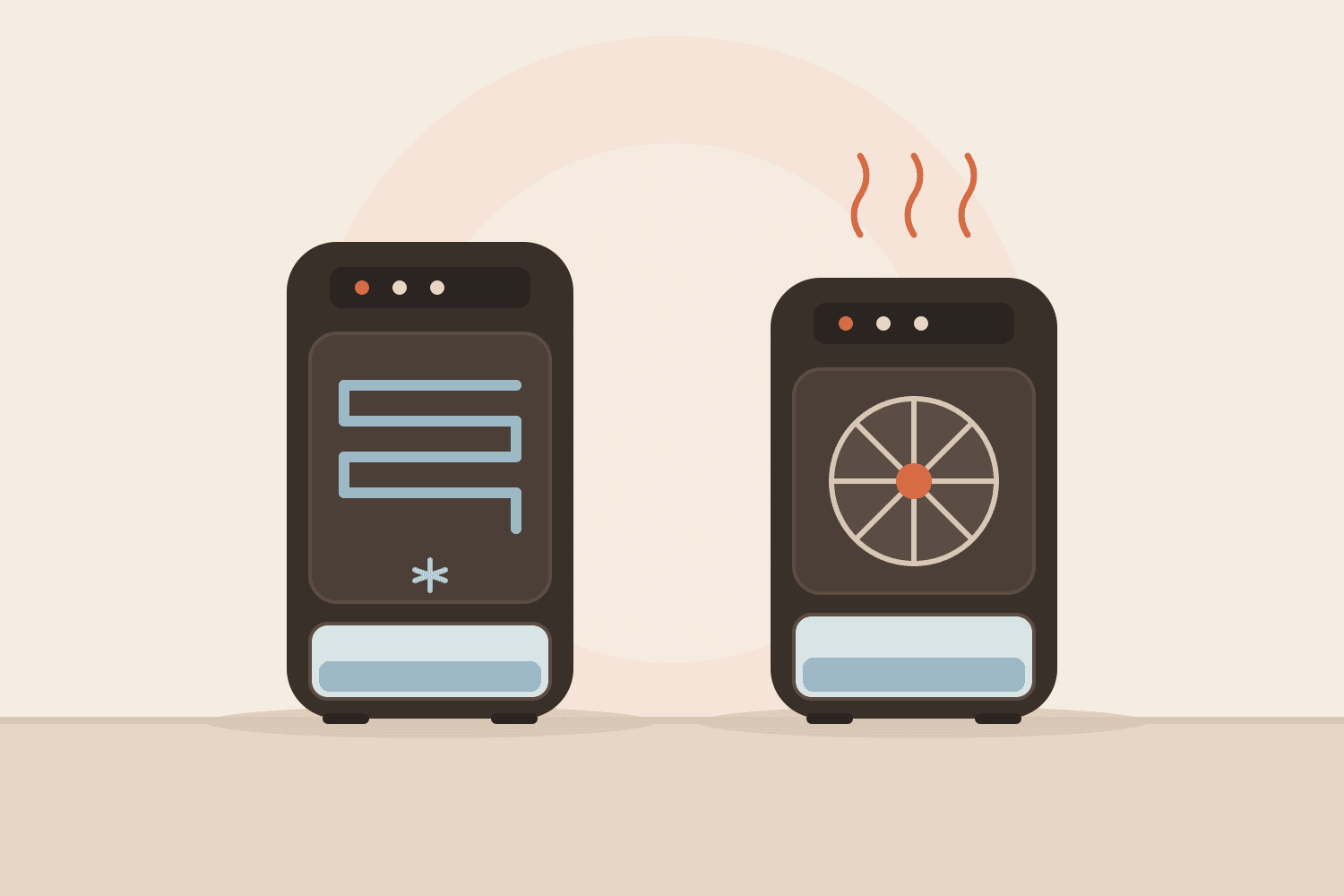
Comparison
How compressor and desiccant dehumidifiers differ in room temperature, rated extraction, power, weight, noise and upkeep, using maker figures.
Litres per day is the rating for how much water a unit removes in 24 hours under stated test conditions. Tank size is how much water the unit can hold before it stops. Which? makes the same distinction, and in this listing the tanks run from 1.5 L to 4 L whatever the rating.
Neither is better in every room. Which? says refrigerant (compressor) models typically struggle in cold spaces and that desiccant models work in both warm and cold ones, while Electrical Safety First says compressors are generally more efficient in warmer temperatures. Match the type to the usual temperature of the room.
No. Which? says any dehumidifier can be used to dry laundry and that, without a laundry setting, you can set the target humidity to 30% to 40% and leave it running. Check how long the laundry mode on a model runs, because makers differ and one manual warns against long or unattended use.
Only if the manual says it is safe. Electrical Safety First advises avoiding running a dehumidifier overnight or while you are away unless the maker specifies it is safe for unattended use. Several models have a night mode, which changes noise and lights, not that safety advice.
We do not rank them. The noise figures are printed without conditions, and Shopicks has not measured any of them. Which? tests quietness and extraction in a climate-controlled room, but its results are behind a paywall.
Amazon only permits prices, ratings and review counts to be shown from its own site or API, and a stale value would mislead you. Each button links to the Amazon.co.uk listing, where you can see the current price, availability and customer reviews.