Buying guide
Portable Electric Heaters for UK Homes: Types, Features and Safety
How to choose a portable electric heater in the UK: oil-filled radiators and ceramic fan heaters, rated watts, controls, running-cost sums and safety limits.
Home & Living
Twelve portable electric heaters from De’Longhi, Pro Breeze, Russell Hobbs and VonHaus: seven oil-filled radiators and five ceramic fan heaters. Each is matched to its exact Amazon.co.uk listing and checked against the maker’s own page, and for six of them we also read an instruction manual. Rated power, controls, clearances and the rules on unattended use are shown as the makers print them, and a detail the papers do not cover is marked as missing, not guessed. Shopicks has not tested any of them.
Use the Type filter to separate the radiators from the fan heaters. The advice below covers what the cards show and where the makers’ papers leave gaps, and the buying guide and comparison linked beneath the list go further on choosing between the two technologies.
Browse all 12 modelsRead our portable electric heaters buying guide
General information, not a damp survey or an electrical safety inspection. If damp or mould keeps coming back, ask a qualified professional or your landlord to find the cause, and stop using any heater with a damaged plug or cable.
Our editorial choice to illustrate this subcategory. Featured picks are not a ranking and are not the result of side-by-side testing.
A dial-controlled oil-filled radiator with a 24 hour dial timer, for people who prefer dials to a digital panel and will follow a manual that sets out distances and a rule against sleeping near it.
Featured as the oil-filled example whose maker papers can be read in full. Pro Breeze's manual gives the rating, the controls, two levels of overheat protection, its distances and its rules on sleeping and unattended use, and Amazon.co.uk's rows carry the PB-H02-UK part number. It illustrates the type and is not a ranking.
May suit: People heating a room they are in, who want a dial thermostat and a built-in timer and are happy to read a manual first.
Worth checking: The manual, Pro Breeze's page and Amazon disagree on size and weight, and the manual and Amazon give different wattages for the three settings, so check the rating label on the unit. The manual says not to use it while sleeping.
Checked against: Pro Breeze UK (opens in a new tab), Pro Breeze PB-H02 instruction manual (PDF) (opens in a new tab)
Showing 12 of 12 products
A dial-controlled oil-filled radiator with a 24 hour dial timer, for people who prefer dials to a digital panel and will follow a manual that sets out distances and a rule against sleeping near it.
A digital oil-filled radiator with an Eco mode, a remote control and a timer, for people who want to set a temperature in degrees.
A 2000 W oil-filled radiator with an electronic panel, a 0.5 to 24 hour timer and an Eco function, for people who want digital control.
A 1500 W oil-filled radiator with the same electronic panel and timer as the larger Radia S, for people heating a smaller space.
A 2000 W oil-filled radiator with a chimney design and a digital timer, for people who want an electronic panel and can accommodate a heavier unit.
A dial-controlled 2500 W oil-filled radiator with overheat and tip-over protection, for people who want a plain heater with no timer.
A plain 2000 W oil-filled radiator with three power switches and a thermostat dial, for people who want no timer or panel.
A compact ceramic tower with oscillation and a dial thermostat, for warming the space around you in a small room while you are in it.
A small ceramic fan heater with two power levels and oscillation, for short spells of warmth in a small room while you are there.
A 2000 W ceramic tower with a remote control and Eco and anti-freeze functions, for people who want a tower with a listed tip-over cut-out.
A 2000 W ceramic tower with a remote control and a washable dust filter, for people who want a filter on the air intake.
A compact oscillating ceramic fan heater with a control panel on top and a remote control, for people who want timer and temperature control in a small body.
Before you buy
An oil-filled radiator heats sealed thermal oil inside a finned body, and the fins give the warmth to the room. None of the seven in this list has a fan. A ceramic fan heater passes air over a heated ceramic element and blows it out, so it moves air and, Which? says, gets going much more quickly than other types, though it can be noisy. Electrical Safety First adds that an oil-filled radiator takes longer to warm up and keeps giving out heat after it is switched off, and that its fins stay hot for a while.
That does not make one type more efficient than the other. Each turns the electricity it uses into heat. The useful questions are how the warmth reaches you, how long you need it for and what the heater asks of you in return. Our comparison goes through those, and the buying guide gives the full checklist.
Makers print a rated input in watts. In this list the radiators run from 1500 W (the De’Longhi Radia S TRRS0715E.G) to 2500 W (the two Pro Breeze models and the Russell Hobbs), and the fan heaters are all 2000 W on their highest setting, dropping to 1000 W or 1200 W on low. A higher figure means more electricity drawn while the heater is on. It does not mean a warmer room, which depends on insulation, draughts, outside conditions and any other heat in the home.
Room sizes are the makers’ own claims and use different units. Pro Breeze gives square metres, up to 30 m2 for its 2500 W radiators and up to 15 m2 for its fan heaters, while De’Longhi gives a working capacity in cubic metres, 60 m3 for the 2000 W radiators and 45 m3 for the 1500 W one. Every one of the twelve also carries a caution that it is only suitable for well insulated spaces or occasional use, and Which? says portable heaters are not designed to heat a whole home.
Five of the seven radiators have a built-in timer: the two Pro Breeze models, with a 24 hour timer (a dial of 15 minute segments on the PB-H02), and the three De’Longhi models, which set start and off times from 0.5 to 24 hours on a panel. The Russell Hobbs and VonHaus radiators have none. Among the fan heaters only the De’Longhi Capsule You&Me lists a timer on the maker’s page. De’Longhi’s pages for the two towers do not mention one, although Amazon’s titles do, and the two Pro Breeze fan heaters have none. Four models come with a remote control.
A built-in timer is not permission to add a plug-in one. The Pro Breeze and Russell Hobbs manuals both say not to use the heater with an external programmer or timer switch, and Pro Breeze and Russell Hobbs also advise against extension leads.
The radiators are the heavy ones. VonHaus prints 6.9 kg for its 9 fin model and De’Longhi prints 14.36 kg for the Dragon 4, with the Pro Breeze and Radia S models in between. All seven have castors or wheels, and the Pro Breeze, Russell Hobbs and VonHaus manuals describe fitting them yourself. The fan heaters weigh between 1.3 kg and 2.36 kg on the makers’ pages.
Sizes and weights often disagree between sources. For the Pro Breeze PB-H02 the manual, Pro Breeze’s page and Amazon give three different sets of figures, and the cards show which source each number comes from. Measure the space against the maker’s figures and check the rating label on the unit when it arrives.
The six De’Longhi pages list rated power, functions and some safety features, but we could not find an English manual for any of them, so their distances and unattended-use rules were not read. The cards say so, and the manual in the box is the authority. Elsewhere the gaps are smaller but real: the Pro Breeze PB-H02 manual does not describe the tip-over switch that Pro Breeze’s page lists, VonHaus prints no clearance distance, and Russell Hobbs gives three different clearances in one manual.
A missing line on a card means the information we read did not cover it. It is not a sign that the feature is absent, and it is not a sign that it is present.
Electrical Safety First says to stand a heater on a level surface, keep it at least one metre from anything that can burn, avoid an extension lead and never leave it running unattended or while you are asleep. The manuals we read agree on the last point: the Pro Breeze manuals say not to use the heater while sleeping or near a person who is, and the Russell Hobbs and VonHaus manuals say not to leave it unattended. Distances differ by maker, from 50 cm on all sides in the Pro Breeze manuals (with combustible items at least 0.9 m away) to the 1 m Electrical Safety First gives, and where they differ the larger distance is the safer reading.
Hot surfaces can burn children and pets, and a tip-over or overheat cut-out lowers some risks without removing the risk of fire. Never dry clothes on or close to a heater: Electrical Safety First says so, as do the Pro Breeze and VonHaus manuals, and the Russell Hobbs manual says never to put clothing on top of the heater. Shopicks makes no claim about the safety certification of any model.
We chose models that differ in type, controls and maker, not different colours of one model, and we kept a model only where we could open its exact Amazon.co.uk listing and match it to a maker page. We rejected eleven candidates, among them a Dreo heater whose generation could not be tied to a maker document, a Dimplex tower whose Amazon.co.uk page returned an error on four attempts, and heaters from brands with no maker page we could find.
On 25 October 2026 we searched the government’s list of product safety alerts, reports and recalls for each brand and model and found no entry for any of the twelve. That search is only as complete as the list’s own text search, and it is not a statement that a product is free of faults. The list is not a ranking. One card is marked as a featured example to illustrate the page, and the card says why. Prices, stock, star ratings and review counts are not shown because Amazon only permits them from its own site, so each button takes you to Amazon.co.uk to check the current price and availability.
Level surface, one metre from combustible items, extension leads, drying clothes, unattended and sleeping use, and how oil-filled radiators behave. The page shows no date.
Average running cost per hour for oil-filled, fan and convector heaters, warm-up speed and heat after switch-off. The page is dated 25 September 2026. Model scores are behind a paywall and are not used.
Fan heaters against oil-filled and convector heaters, and that portable heaters are not designed to heat a whole home. The article also quotes older unit rates, which are not used here.
Searched by brand, model code and ASIN. No entry names any of the twelve listed heaters.
Rated power, settings, controls, clearances and unattended-use wording are from the makers’ pages and manuals recorded in the portable heater evidence dataset.
Used only to confirm the title, manufacturer and model number behind each ASIN. No Amazon prices, ratings, images or descriptions are used.
Buying guide
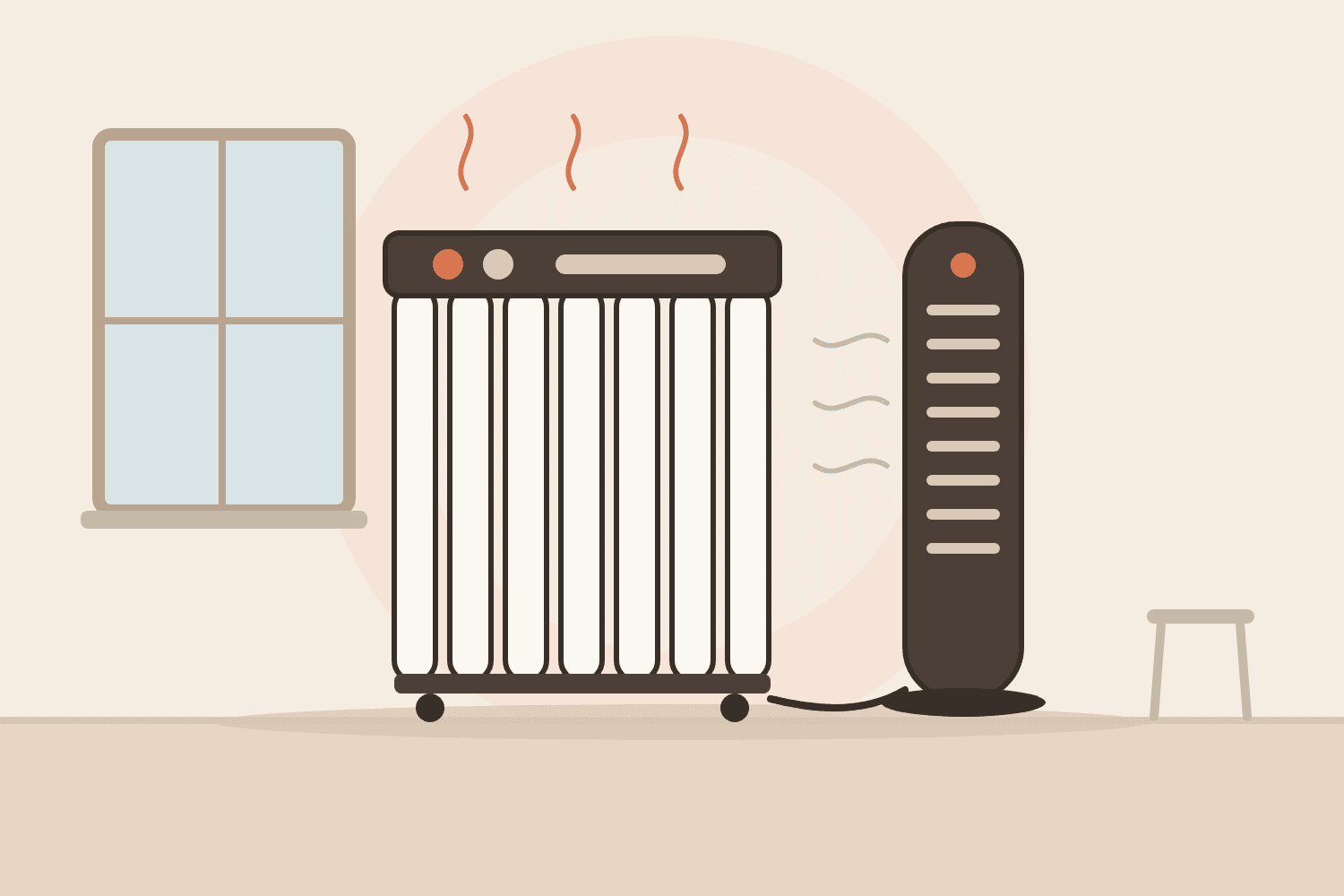
How to choose a portable electric heater in the UK: oil-filled radiators and ceramic fan heaters, rated watts, controls, running-cost sums and safety limits.
Buying guide
How to choose a heated clothes airer in the UK: winged, tiered, pod and cabinet types, what capacity figures count, space, electricity arithmetic and safety limits.
Comparison
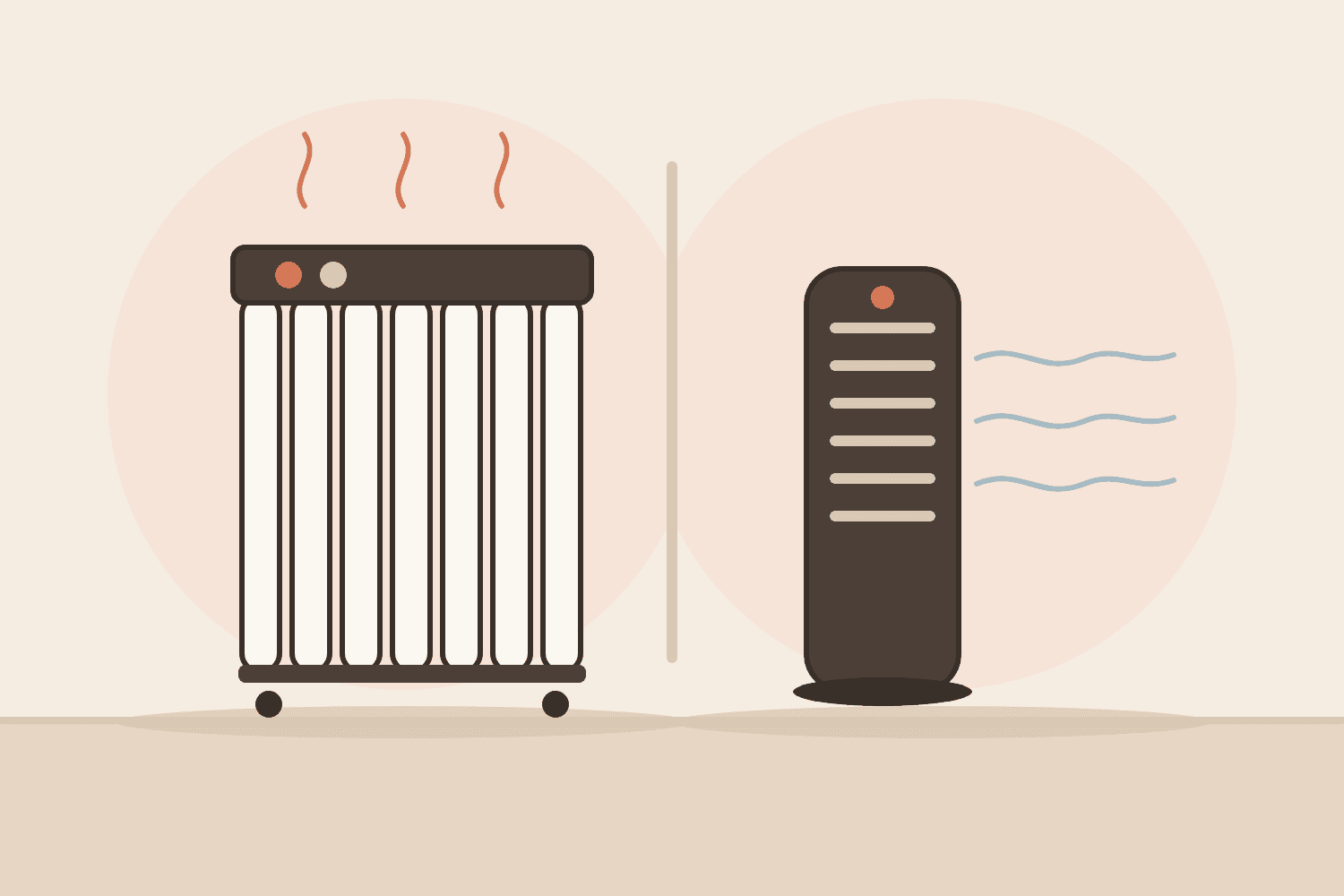
How an oil-filled radiator and a fan heater differ in warm-up, retained heat, noise, hot surfaces, positioning and running cost, and which suits which room.
Not because of the technology alone. While both are on, a 2000 W radiator and a 2000 W fan heater draw the same electricity. Which? found oil-filled radiators averaged 33p an hour against 60p for fan heaters in its tests, but those are averages for the models it tested, at its settings and at the price cap rate it used. Our comparison explains what can make real consumption differ.
Electrical Safety First says never to leave a heater running unattended or while you are asleep, and the Pro Breeze manuals say not to use the heater while sleeping. Shopicks does not recommend running any of these overnight.
No. Electrical Safety First says never to dry clothes on or near a heater, and the Pro Breeze and VonHaus manuals say the same, while the Russell Hobbs manual says never to put clothing on top of it. A heated clothes airer is built for the job, and we list those separately.
No. They are the makers’ own claims, in different units, and what a heater achieves depends on your insulation, draughts and the weather. Every heater in this list carries a caution that it is only suitable for well insulated spaces or occasional use.
Amazon only permits prices, ratings and review counts to be shown from its own site or API, and a stale value would mislead you. Each button links to the Amazon.co.uk listing, where you can see the current price, availability and customer reviews.