Home & Living
Heated Airer vs Dehumidifier for Drying Clothes: What Each Does
How a heated clothes airer and a dehumidifier each dry washing indoors: heat, airflow, where the moisture goes, power, noise, safety, and when using both makes sense.
A heated airer warms your washing, it does not dry the air. This guide explains the four shapes on sale, what the capacity numbers count, how much room you need, how to work out electricity use for yourself and what the manuals ask you not to do.
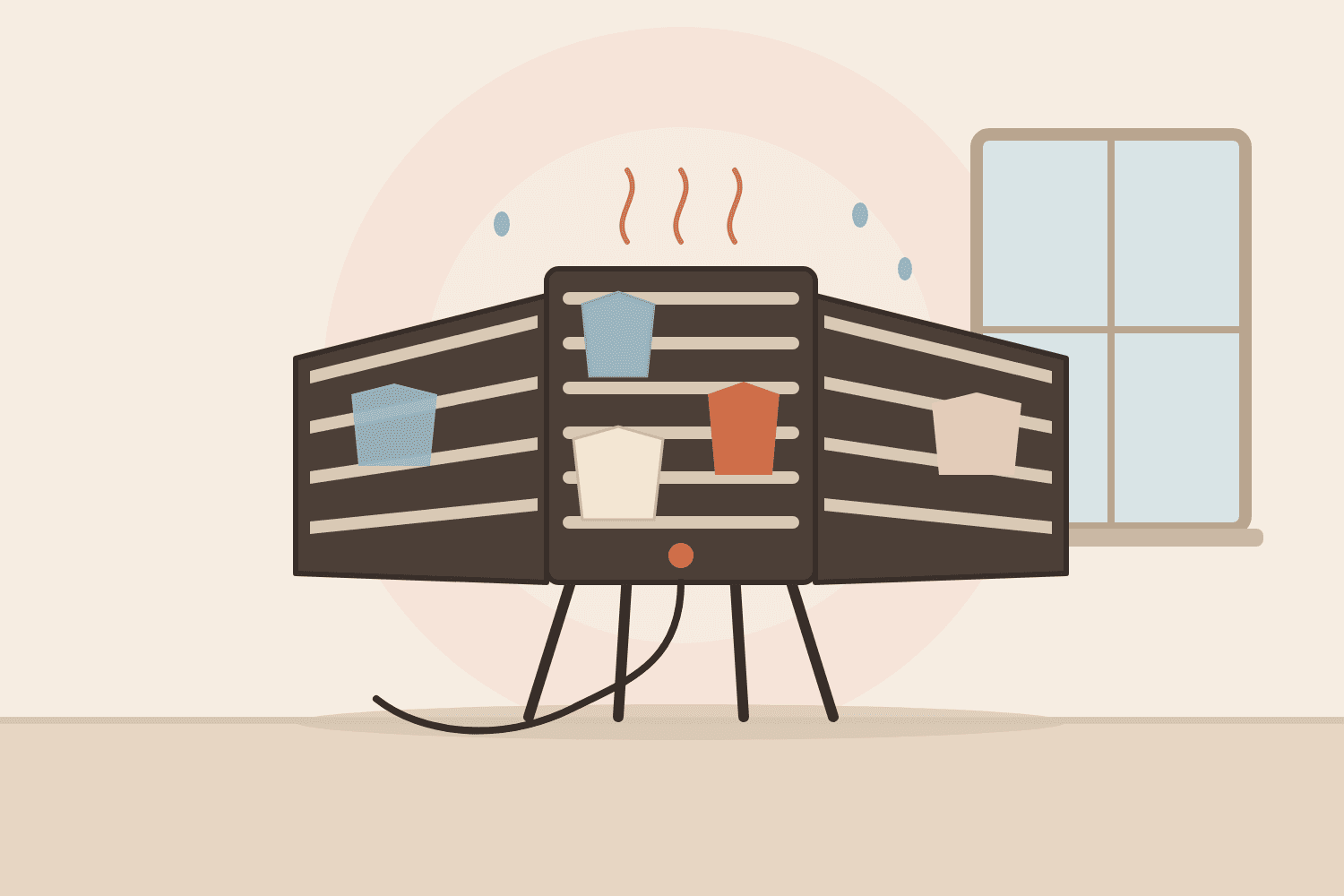
Wet washing in a UK winter has to go somewhere. A heated clothes airer is a rack with electrically heated bars, or a small fan heater under a cover, that warms the laundry so the water leaves it faster than it would on an unheated rack. In its own tests Which? found that heated airers took between four and seven hours to dry a small cotton load, and that drying pods averaged about two hours.
That makes the choice less about the biggest number on the box and more about four questions. What shape suits the room? How much do you need to dry at once? Is the electricity use acceptable for the hours you will run it? Can you follow the safety rules in the manual? Three models show how a winged airer, a tiered airer with a timer and a drying pod differ, and our listing has all eleven.
Shopicks has not tested any heated airer or measured any drying time. The figures come from maker pages and booklets, from Which? and from public safety advice, all read on 25 October 2026, and the guide says where sources disagree. It is different from our listing, which shows the models, and from our comparison, which sets a heated airer against a dehumidifier.
Winged, no timer, full manual
Beldray
A winged airer with 18 heated bars and a plain on/off switch. It is the example of a type whose manual spells out distances and what not to do.
Research-based assessment
Our assessment is based on product specifications, manufacturer information, market research and comparison with competing products. We have not physically tested this product.
A room where you can watch it run, for someone who wants a simple winged airer with the rules written down.
Beldray’s page and manual agree on the 230 W output and the 15 kg load, and the Amazon.co.uk listing carries EH1156 and EH1156AMZ in its model rows. The manual is the clearest on distances and overnight use of the winged models we read. We have not tested its drying.
Tiered, 1 to 12 hour timer
Dry:Soon
A three-tier tower with a built-in timer that switches it off up to 12 hours ahead. It is the example of a tower airer with a booklet that gives power, size and a 24 hour limit.
Research-based assessment
Our assessment is based on product specifications, manufacturer information, market research and comparison with competing products. We have not physically tested this product.
A household with a lot of washing and a spot for a tower, for someone who wants a built-in timer and a maker booklet.
Amazon.co.uk’s Model Number and Manufacturer Part Number rows both read 24909, which is the Lakeland booklet’s model and the Lakeland site’s SKU for the Deluxe. Amazon’s size table and the booklet differ only in the order of the numbers. We have not tested its drying.
Pod, fan heater under a cover
Dry:Soon
A tripod frame with a fan heater at the base and a zipped cover, for clothes on hangers. It is the example of a pod, which heats air and not bars.
Research-based assessment
Our assessment is based on product specifications, manufacturer information, market research and comparison with competing products. We have not physically tested this product.
A few shirts, blouses and delicates on hangers, for someone who has less to dry at a time.
Lakeland’s page and booklet agree on 1000 W, 10 kg and 12 hangers, and the Amazon.co.uk listing carries 53211 as its Manufacturer Part Number. Lakeland’s page makes drying-time and noise claims with no test conditions, which we do not repeat as results. We have not tested its drying.
| Beldray EH1156 (winged) | Dry:Soon Deluxe 24909 (tiered) | Dry:Soon Drying Pod 53211 (pod) | |
|---|---|---|---|
| What heats the washing | Heated bars | Heated bars | A fan heater blowing warm air under a cover |
| Rated power | 230 W | 300 W | 1000 W |
| Maximum load | 15 kg | 15 kg | 10 kg |
| Drying space as printed | 12 m over 18 bars | 21 m (Lakeland page) | 12 hangers |
| Size | 91 x 54 x 148 cm (page) | Open 74 x 70 x 132.5 cm, closed 74 x 8 x 132.5 cm | 62 cm across x 146 cm high |
| Weight | Not stated by the maker | 5.9 kg | 3.1 kg |
| Timer | None, on/off switch | 1 to 12 hours | 30 to 180 minutes, or on |
| Cover | None described | Sold separately | Part of the product, required |
| Unattended and continuous use | Not unattended, not overnight, not for extended periods | Off after 24 hours and about 2 hours to cool | Not described beyond the timer; 0.5 metres from heat or water |
Which? describes a heated airer as a tower-like structure or a winged frame that heats clothes through bars. A winged airer is a low, wide rack with fold-out wings. A tiered airer (often called a tower) stacks heated shelves, usually three, on a smaller footprint, and some fold their shelves up or down to use half the space. Our listing has two winged models and six tiered ones.
A pod or cabinet is a different machine. A fan heater at the base blows warm air up through clothes on hangers under a zipped cover, and the makers rate them at 1000 W to 1200 W, against 198 W to 360 W for the heated-bar models in our listing. Which? says pods work like a hairdryer, dry faster but hold less, and are fine for everyday items but not for bedsheets or duvets. A compact heated rack is simply a smaller tiered airer: the Dry:Soon Mini folds to 8 cm deep and is rated 198 W.
There are three different figures and none of them is a drying result. Metres of drying space add up the length of every bar. A hangers figure counts how many hangers hang inside a pod or cabinet. A kilograms figure is the load the frame will carry. Makers choose which to print, and one model can print two. The Benross X-Frame lists 12.5 m of heated bar and 13.5 m including its non-heated bars, and the Tri:Mode booklet prints a 30 kg load but no metre figure.
Which? expresses capacity in medium T-shirts so models can be compared, but its model results are behind a paywall and Shopicks has not used them. A practical rule is to picture your own washing. A couple’s weekly towels, a bed set and a school week’s uniform need bar length, while a few work shirts need hangers. Which? says the savings shrink dramatically for larger loads, because the airer must be used several times to clear one.
Measure the spot where it will stand open and the place where it will be stored. Open sizes in our listing run from a pod about 62 cm across to a winged airer that Benross lists as 142 cm wide, and folded depths from about 6.5 cm to 10 cm for the models that print them. Makers print dimensions in different orders, and Amazon’s tables do not always match the maker’s page, so use the maker’s figure and check the orientation.
Clearance matters as much as footprint. Beldray’s manual asks for furniture, curtains and other flammable material at least 1 metre away and for the lowest heated rail to be at least 600 mm above the floor. Lakeland’s pod and cabinet booklets ask for 0.5 metres from heat or water, and its winged airer booklet (for a model that is not in our listing) asks for 60 cm from baths and showers. Whatever you choose, leave the distance the manual gives, which is a minimum and not a target.
Energy in kilowatt-hours (kWh) is rated power in watts, divided by 1,000, multiplied by the hours it runs. Cost is the kWh multiplied by your unit rate in pence, which is on your bill. Rated power is only half of that sum: the other half is how long the airer runs for your load, and neither is a measured cost.
As an illustration, take a round 25p per kWh, which is not a current tariff. A 230 W airer for 5 hours is 0.23 kW x 5 = 1.15 kWh, or about 29p. A 360 W model for 6 hours is 2.16 kWh, about 54p. A 1000 W pod for 2 hours is 2 kWh, about 50p. The hours are assumptions placed within the ranges Which? reported for its tests (four to seven hours for heated airers and about two for pods), and the power is held constant. Real use differs: the makers do not say how often a thermostat switches the heating, and none of these is a measurement, a maximum or a running cost.
Which? adds three points worth knowing. Every airer it tested simply switches on and off as a whole, so a half-empty airer heats bars that dry nothing. In its 22 October 2026 article it put the average cost of the heated airers it tested at about 7p an hour and of the drying pods at about 25p an hour at 26.32p per kWh, and its 27 March 2026 article gave the airer average as 8p an hour at 24.67p per kWh. And heated airers suit small loads, while for larger loads the saving shrinks or disappears, so a heat pump tumble dryer you already own may be the cheaper way to dry. We have not assumed an airer is cheaper than any other method.
Which? reported that heated airers typically took four to seven hours to dry a small (2.15 kg) cotton load, with tower airers averaging 4 hours 40 minutes and winged ones 5 hours 54 minutes, and that pods averaged about two hours. Those are Which?’s results for the models it tested, not a promise for yours. It also notes that results assume the washing is regularly rotated, and that airers are not very effective at drying the parts of clothes that do not touch the heated bars.
Spin the washing as dry as you can first. Beldray’s manual says a faster drying time comes from spinning the garments before hanging, and Lakeland’s pod and cabinet booklets ask for clothes to be spin-dried or well wrung. Hang garments so air can reach them, do not stack thick items on one bar, and expect towels and bedding to take longest. A maker’s statement such as ‘dries in one to three hours’ has no test conditions printed and is not a result.
A built-in timer switches the airer off at the end of a set time. In our listing the Dry:Soon Deluxe runs from 1 to 12 hours, the Tri:Mode from 1 to 8 hours with a temperature of 30°C to 60°C, the Dry:Soon pod from 30 to 180 minutes, the Beldray pod on a dial set in minutes, and the cabinet from 10 minutes to 3 hours, with a separate continuous setting that has no automatic switch-off and that its booklet says not to run for more than 6 hours. The other models are plain on/off. A built-in timer is not a licence to use a plug-in one: Beldray’s manual, Lakeland’s booklets and the Beldray pod manual say not to use these appliances with an external timer, programmer or remote switch.
A cover is a different story for each type. Pods and the cabinet cannot be used without theirs, and Lakeland says so in its booklets. For the bar airers a cover is an accessory, and Lakeland’s booklets say to use only accessories it recommends. Which? does not say how much a cover changes drying and neither do we. A thermostat or thermal cut-out is described for the Dry:Soon Mini’s bars and the Beldray pod, and the maker is the only source for it.
These are heat-producing appliances, and the manuals are specific. Beldray’s EH1156 manual says not to leave the airer unattended while connected, not to use it for extended periods and not to leave it plugged in or operating overnight. Lakeland’s booklets say a heated airer is not designed to be kept on indefinitely and should be switched off after 24 hours and left to cool for about 2 hours. The pods have a metal fan, and the cabinet has heater vents, that become extremely hot, and the booklets say to keep hands away, never insert objects into the vents and check that the airflow is not blocked.
Which? says most brands advise against leaving a heated airer running while you sleep or when it is completely unattended, and that the risk increases if it is overloaded with thick items, placed too close to curtains or furniture or plugged into a cheap extension lead. West Sussex Fire and Rescue says never to leave electrical items plugged in or unattended, especially at night, never to overload an extension lead and not to dry clothes on portable heaters. Where a model has no booklet we could read (the three BLACK+DECKER models and the Minky), follow the manual in the box. Shopicks does not claim any safety certification for any model.
Drying clothes releases moisture, and a heated airer adds it to the room faster, not less of it. Which? says to avoid using a heated airer in a room with little or no air circulation, because moisture will often collect in the corners of ceilings and invite mould, and suggests opening a window, running a dehumidifier or using a window vac. It also says heated airers do not noticeably heat a room and are not a replacement for your heating.
GOV.UK counts drying laundry as one of the everyday sources of indoor moisture. A heated airer is therefore not a way to solve damp or mould, and it can add to a problem that is already there. If you see condensation or mould returning, our condensation guide sets out the order to work in, and our laundry guide and comparison explain how a dehumidifier handles the same moisture.
Buying on drying space alone, without checking whether it is metres, hangers or kilograms. Assuming a higher wattage is faster or a lower wattage is cheaper, when neither follows without the hours. Buying a pod for bedding, or a tower for a room with no space to open it. Ignoring the folded size when the cupboard is the real limit. Treating a maker’s running cost per hour as a fact, when it depends on a unit rate the maker chose.
The mistakes that matter most are about use. Overloading the frame, running it unattended or overnight against the manual, putting it close to curtains or furniture, using an external timer when the manual says not to, and drying in a closed room with no ventilation. A heated airer is a good fit for a household that can watch it run and keep the room aired, and a poor one for one that cannot.
Our assessment is based on product specifications, manufacturer information, market research and comparison with competing products. The products on this page have not been physically tested by Shopicks.
Picture your washing first. Metres of bar suit towels and bedding, hangers suit shirts and blouses, and the load limit is separate. Which? says the savings from a heated airer shrink dramatically for larger loads, because it must be used several times. Then check the open size, the folded size and the clearance in the manual.
Multiply the rated power in kilowatts (watts divided by 1,000) by the hours it runs, then by your unit rate. A 230 W airer for 5 hours is 1.15 kWh. The hours are the part we cannot give you, because Shopicks has not measured any drying time.
It can be for a small load, but not always. Which? found the saving shrinks for larger loads that need several runs, and advises keeping a heat pump tumble dryer if you have one. A heated airer is cheaper to buy, and that is a different matter from running cost.
Only if the manual says it is safe. Beldray’s manual says not to leave the airer operating overnight or unattended, Lakeland’s booklets give a 24 hour limit, and Which? says most brands advise against running one while you sleep.
They add moisture to the air as the washing dries, so they can. Which? says to avoid using one in a room with little air circulation and suggests opening a window or running a dehumidifier.
Amazon only permits prices, ratings and review counts to be shown from its own site or API, and a stale value would mislead you. Each button links to the Amazon.co.uk listing, where you can see the current price, availability and customer reviews.
Airer types, drying times for a small cotton load, load size against a tumble dryer and the unattended-use warning. Published 1 October 2026. Product rankings are behind a paywall and are not used.
Average hourly cost of airers and pods at 26.32p per kWh, and the advice on air circulation. Published 22 October 2026.
Tower and winged averages, whole-airer switching, and moisture. Costs at 24.67p per kWh. Published 27 March 2026.
Unattended electrical items, overnight use, extension leads and drying clothes on heaters. Last updated 29 April 2025 on the page.
Drying laundry as a source of indoor moisture. Updated 1 April 2026.
Power, load, size, timers, covers and safety wording are from the makers’ pages and booklets recorded in the heated airer evidence dataset.
Used only to confirm the title, manufacturer and model number behind each ASIN. No Amazon prices, ratings, images or descriptions are used.
Home & Living
How a heated clothes airer and a dehumidifier each dry washing indoors: heat, airflow, where the moisture goes, power, noise, safety, and when using both makes sense.
Home & Living
Drying laundry indoors with a dehumidifier: room set-up, clearances, laundry settings, energy use and how it compares with a heated airer or tumble dryer.
Home & Living
How to choose a dehumidifier in the UK: compressor or desiccant, litres per day and test conditions, controls, tanks and noise, with five models checked.
Home & Living
Why window condensation forms, what to try before a dehumidifier, when one helps and when it does not, and what renters can ask a landlord, with GOV.UK advice.