Home & Living
Portable Electric Heaters for UK Homes: Types, Features and Safety
How to choose a portable electric heater in the UK: oil-filled radiators and ceramic fan heaters, rated watts, controls, running-cost sums and safety limits.
Home & LivingComparison
Both turn electricity into heat. What differs is how the warmth arrives, how long it lingers and what each heater asks of you, and those details decide which suits a home office, a living room or a spare room.
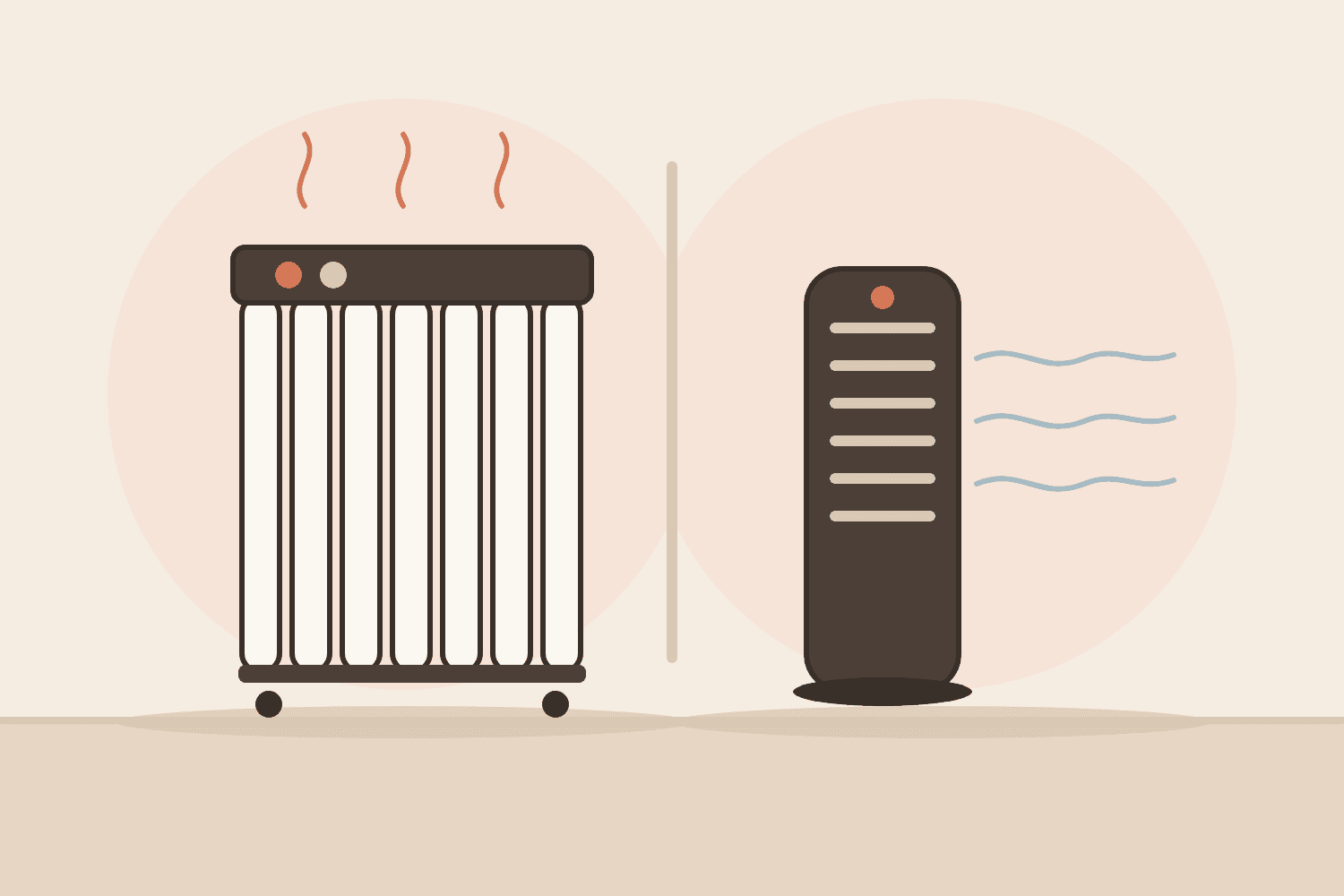
A sealed body of thermal oil that an element heats, giving warmth from its fins and, in every model we list, with no fan. Our listing has seven, and the VonHaus 2000W 9 Fin radiator is the worked example here.
A room you are in for a good while, where steady warmth and no fan noise matter more than speed.
Research-based assessment
Our assessment is based on product specifications, manufacturer information, market research and comparison with competing products. We have not physically tested this product.
A heated element with a fan that blows the warmed air into the room. All five in our listing use a ceramic element, and the Pro Breeze PB-H07 ceramic tower is the worked example here.
Warmth soon in a small room, for someone who will be there while it runs and can keep the clearances in its manual.
Research-based assessment
Our assessment is based on product specifications, manufacturer information, market research and comparison with competing products. We have not physically tested this product.
Which? says fan heaters get going much more quickly than other types, and that oil-filled heaters warm the room slowly but for longer. In its oil-filled radiator tests, its testers typically got about half an hour more of heating after switching off before the temperature began to fall. Electrical Safety First says the same of the type: it takes longer to warm up and keeps giving out heat after it is switched off.
That retained warmth is energy the heater took in while it was on. It is not free, and it does not on its own make the radiator cheaper to run than a fan heater delivering the same electrical input for the same time. What it changes is the pattern: a radiator can be switched off a little before you stop needing the heat, and a fan heater has to stay on while you want the warmth.
A fan heater moves air, so you feel warmth where its output is directed and the room fills with it more quickly. The tower we use as the example oscillates 80 degrees on Pro Breeze’s page, which spreads the airflow, and the maker’s four settings pair 1000 W or 2000 W with or without oscillation. A radiator has no fan in any model we list and warms the room from its fins, which feels gentler and takes longer to make a difference.
Noise follows from that. A fan makes some. Which? says fan heaters can be noisy, and makers print figures such as 49 dB for the Pro Breeze tower and 45 to 48 dB for the De’Longhi Capsule You&Me, but no maker prints the distance or the setting, so the numbers cannot be compared. A radiator is quieter in use, though it can crackle or pop when first switched on, as the VonHaus and Pro Breeze PB-H02 manuals say.
Both types turn the electricity they use into heat, so the rated input is what matters while the heater is on. A 2000 W oil-filled radiator and a 2000 W fan heater each draw 2 kW when running flat out, which is 2 kWh in an hour and 53p at Ofgem’s 26.32p per kWh average for 1 October to 31 December 2026. That is a constant-power sum at an average rate, not a household bill or an upper limit, and your own unit rate will differ. A higher rating is not a sign of better efficiency: it means more electricity drawn while the heater is on.
Real consumption differs because of what the thermostat does. Once the room reaches the set temperature, the heating switches off and then on again to hold it, so the heater is drawing its full input for only part of the time. How big a part depends on the heater, the settings, the room’s heat loss and the weather. Which? reports that oil-filled radiators averaged 33p an hour against 60p for fan heaters in its tests, at the 25.73p per kWh it used, and that the fan heaters in its latest test cost anything from 8p to 80p an hour at 26.32p per kWh. Those are averages and ranges for particular models in Which?’s test room, so they are not a rule that one technology is always cheaper.
Heater makers also make claims, such as a fan heater with a ceramic element using less electricity, or a radiator heating a room faster than a fan heater, and print no test conditions with them. We do not repeat them. A heater’s thermostat, its settings and how long you run it will do more to decide your bill than the label on the technology.
Electrical Safety First says tip-overs are easily caused by young children or pets, that a radiator’s fins stay hot after use and that the hot air from a fan heater can be intense. Neither type is safe to treat casually. The Pro Breeze manuals say some parts of the product can become very hot and cause burns and that particular attention is needed where children and vulnerable people are present, and the VonHaus manual warns to keep children and pets away from the heater during use.
Cut-outs help and they do not remove the risk of fire. The Pro Breeze fan heater manual describes a tip-over switch and an overheat cut-out, the Russell Hobbs and VonHaus radiator manuals describe both, and the De’Longhi pages we read list some of them and give no manual to confirm how they work. Check the manual for your own model, because safety behaviour differs between heaters of the same type.
The general rules are the same for both. Electrical Safety First says to put the heater on a level surface, keep it at least one metre from anything that can burn and avoid an extension lead. The Pro Breeze manuals ask for 50 cm clear on all sides, with 1 m recommended on the radiating side of the tower, and combustible items at least 0.9 m away. VonHaus prints no distance for its radiator, and the Russell Hobbs radiator manual gives 100 cm, 90 cm and 15 cm in different places. Where distances differ, use the larger one.
A radiator is large and stays where you put it, so a wall socket nearby matters. A fan heater is easy to pick up and aim, which also makes it easy to put too close to a chair, a curtain or a bed. Neither should be used to dry clothes: Electrical Safety First says never to dry clothes on or near a heater, and the Pro Breeze and VonHaus manuals say the same.
For a short spell in one small room, such as a home office, a fan heater is the natural choice and keeps the heater small, as long as it stands clear of the desk and chairs. For an evening in a living room, an oil-filled radiator gives steadier warmth without a fan, as long as you are comfortable with its weight and with it taking time to make a difference. Which? says electric heaters cost less for short bursts in one small area and that central heating is probably better over a full day.
In both cases the room limits what either can do. All twelve heaters in our listing carry a caution that they are only suitable for well insulated spaces or occasional use. If the room is draughty or poorly insulated, the better step may be to deal with that before buying a second heat source. Neither type should be left running unattended, and Shopicks does not recommend running either overnight.
| Oil-filled radiator (VonHaus 2500889) | Ceramic fan heater (Pro Breeze PB-H07) | |
|---|---|---|
| Rated input | 2000 W | 2000 W |
| Cost for 1 hour at the rated input | 53p at 26.32p per kWh, constant power | 53p at 26.32p per kWh, constant power |
| Heat settings | 800 W, 1200 W and 2000 W | 1000 W or 2000 W, with or without oscillation |
| Thermostat | Adjustable dial | Temperature dial that works as a thermostat |
| Timer | None | None described |
| Fan | None described | Fan with 80 degree oscillation on the page |
| Tip-over and overheat protection | Tip switch and overheat cut-out in the manual | Tip-over switch and overheat protection in the manual |
| Clearances | Space on all sides, no distance printed | 50 cm on all sides, 1 m on the radiating side |
| Sleeping and unattended use | Not unattended, not for extended periods without supervision | Not while sleeping, never unattended |
| Weight | 6.9 kg (VonHaus page) | 2.35 kg (manual) |
| Size | H63 x W44 x D24 cm (VonHaus page) | 200 x 200 x 520 mm (manual) |
| Cable | 1.5 m (VonHaus page) | 139 cm (Pro Breeze page) |
Types, rated watts, controls, running-cost sums and the safety rules that apply to both technologies.
Twelve oil-filled radiators and ceramic fan heaters, each checked against the maker’s papers.
If the aim is drying washing, a heater is the wrong tool and a heated airer is built for the job.
A third type that Which? tests separately. Planned, and we make no recommendation about them beyond what Which? says.
A different design from oil-filled radiators, which Which? says work in the same way. Planned, and not counted as oil-filled here.
Our assessment is based on product specifications, manufacturer information, market research and comparison with competing products. The products on this page have not been physically tested by Shopicks.
Not because of the technology alone. While both are on, a heater uses the electricity its rating says, so a 2000 W radiator and a 2000 W fan heater draw the same. The difference comes from how often the thermostat switches the heating off and how long you run it. Which? found oil-filled radiators averaged less per hour in its tests, and that is an average for its models.
It depends on the hours. A fan heater suits a short spell because it gets going quickly, and a radiator suits a longer one. Work it out with your own unit rate: the rating in kilowatts times the hours times the rate gives the most it could cost at constant power.
A ceramic fan heater is a fan heater with a ceramic element, so it is not a separate efficiency class. All five fan heaters in our listing are ceramic. Makers that claim savings from the element print no test conditions, so we do not repeat them.
Which? says fan heaters get going much more quickly than other types and that oil-filled heaters warm the room more slowly but for longer. How fast any heater warms your room depends on its output, the room’s size and its heat loss.
Neither type can be called safe in general. Both have hot parts, both can be knocked over and both have rules in their manuals about distances and unattended use. Check the manual for your own model, and never leave either running unattended or while you are asleep.
No. A timer or thermostat switches the heater on and off and does not remove the risk. Electrical Safety First says never to leave a heater running unattended or while you are asleep, and Shopicks does not recommend running either type overnight.
Placement, one metre from combustible items, extension leads, drying clothes, unattended and sleeping use, how oil-filled radiators and fan heaters behave, and hot air from fan heaters. The page shows no date.
Average cost per hour for oil-filled, fan and convector heaters at 25.73p per kWh, warm-up speed, heat after switch-off and oil-free radiators. The page is dated 25 September 2026. Model scores are behind a paywall and are not used.
How cost per hour is measured, the range of costs at 26.32p per kWh, how long a medium-sized room takes to warm and the advice on short bursts. The page is dated 16 October 2026. Model results are behind a paywall and are not used.
Fan heaters get going more quickly and can be noisy, oil-filled heaters warm slowly but for longer, and portable heaters are not designed to heat a whole home. The article also quotes older unit rates, which are not used here.
The average electricity unit rate of 26.32p per kWh for 1 October to 31 December 2026 on Ofgem’s Great Britain Direct Debit basis. The page shows no date.
Rated input, settings, clearances, protection and unattended-use wording are from the makers’ pages and manuals recorded in the portable heater evidence dataset.
Used only to confirm the title, manufacturer and model number behind each ASIN. No Amazon prices, ratings, images or descriptions are used.
Home & Living
How to choose a portable electric heater in the UK: oil-filled radiators and ceramic fan heaters, rated watts, controls, running-cost sums and safety limits.
Home & Living
How to choose a heated clothes airer in the UK: winged, tiered, pod and cabinet types, what capacity figures count, space, electricity arithmetic and safety limits.